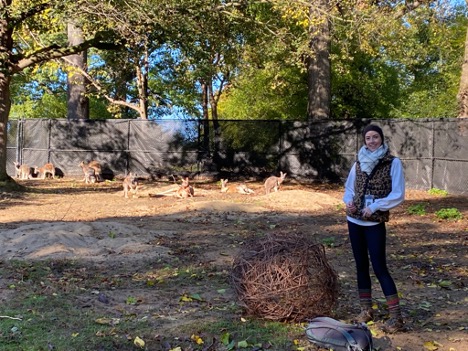
Authored by Julia King, external researcher from Hunter College.
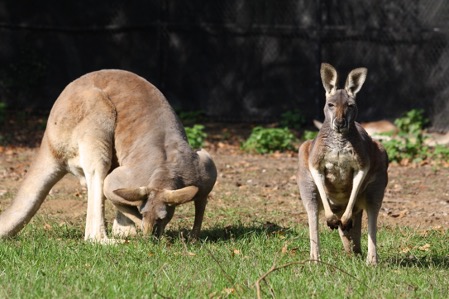
The Detroit Zoo’s Australian Outback Adventure is a favorite among Zoo guests for good reason – you can follow a designated path through the habitat and view 11 red kangaroos and two red-necked wallabies without any barriers! Although the opportunity to cross paths and appreciate these marvelous marsupials up close is an exciting draw for Zoo guests, it begs the question: how do the kangaroos feel about having people in their home?
My name is Julia King, I am a graduate student in Hunter College’s Animal Behavior and Conservation program, and I set out to answer this question in an investigation of kangaroo well-being.
Animal well-being refers to the overall quality of an animal’s physical, mental and emotional health. Well-being can range on a continuum from great to poor and can vary over time and across individuals. Just as no two people are the same, no two animals are the same, and therefore do not have the same well-being. Two individual animals of the same species housed in the same environment may respond to the same stimuli in different ways – one kangaroo may be intrigued by a foreign object in their habitat, while another may be fearful of the same object. Because of this, well-being is best assessed at an individual level.
The Detroit Zoological Society (DZS) strives to ensure all its resident animals have great well-being and are thriving. The unique design of walk-though habitats begs the question: how does the presence of people in the habitat affect the kangaroos? Wild kangaroos may perceive humans as threats and respond fearfully, so it is possible that captive kangaroos may feel similarly. Studies on zoo-living kangaroos, both at the Detroit Zoo and elsewhere, have looked at kangaroo behavior, levels of hormones related to the stress response and habitat use in response to visitor presence. These studies have shown that kangaroos may restrict their spatial use (i.e., use less of their habitat) with higher numbers of visitors in their habitat. However, there are no direct links to suggest visitors are a source of stress for inhabitants of walk-through marsupial habitats.
With the help of DZS animal welfare and mammal staff, I designed a scientific study to see whether the presence of guests inside the kangaroo habitat would have an impact on the kangaroos’ emotional well-being. The idea is simple: give them treats and make them work for it! Like people, animals may be willing to work harder for a reward when they are in a positive headspace and less so when they’re experiencing negative emotions. The kangaroos were offered yummy treats (wheat grass and willow clippings) in feeders with varying levels of difficulty, and the interactions with these treats were analyzed with respect to visitor number. If the kangaroos experience negative emotions when more guests are present, they should be less willing to work for food. Therefore, I predicted that the kangaroos would not work as hard for treats when there were more people present in their habitat.
To make the treats more difficult to access, I used location and a foraging ball challenge feeder. Going to an unusual or avoided area or manipulating a foraging ball to get treats requires more work than eating treats directly off the ground in your favorite place – it’s harder to get ice cream from a shop than from your freezer, and harder still when you must pull it out of a box and unwrap it. Treats were placed out in the kangaroos’ favorite spot, either directly on the ground or hidden within the foraging ball. Treats were also placed in a location in the habitat that kangaroos used less frequently, again either directly on the ground or within the foraging ball.

What happened? As you might expect, the kangaroos were much more likely to eat the treats placed in their favorite spot, while they rarely ventured to the less favored area. There were also no observed effects of visitor presence, meaning, the number of people in the habitat did not influence when and where the kangaroos were willing to get the treats. This may be because at the time of the study, which took place November to December 2021, there were very few guests present in general. Or it may be because many of the kangaroos were born and raised at the Detroit Zoo, and they are used to seeing people on the guest pathway in their enclosure.
An unexpected result from this study was that the kangaroos were far more likely to eat the treats when they were hidden inside the foraging ball than presented freely on the ground. This may seem counterintuitive at first – why would you prefer to unbox and unwrap ice cream when you can just eat it right out of the carton? But it turns out that many captive animals may prefer to work for food even if they don’t have to. This well-documented phenomenon is called contra-freeloading, and it is the basis for many foraging enrichment designs. Environmental enrichment is just that—something that benefits a captive animals’ daily life, usually by eliciting natural behaviors. Food is never free in the wild. By providing an additional challenge like a foraging ball, eating becomes much more interactive and mimics some of the challenges associated with foraging in the wild. Working for food provides mental stimulation and a sense of accomplishment, promoting positive well-being in captive animals.
This study brings some good news to the Detroit Zoo, the kangaroos and all the people who love to visit them. First, the kangaroos do not show any negative responses to the people in their habitat, confirming the results of an earlier study at the Detroit Zoo. Second, we may have inadvertently found a fun and easy way to add some enjoyment and fulfillment to these kangaroos’ lives!
 Detroit Zoological Society Blog