A Song in the Darkness: Audio Loggers and Panama’s Imperiled Amphibians

Authored by Mark Vassallo, Detroit Zoological Society (DZS) Amphibian Department Supervisor.

The cloud forest of central Panama is a unique and mysterious place, full of rare creatures and plants that call these moisture-laden peaks home. At night, the jungle writhes with life as the nocturnal world takes over the mountainsides. In this veil of darkness and nestled in the elevations of these dense jungles, some of the earth’s rarest amphibian species reside. Many of these species are yet to be described by science, and others are considered to be extinct.  As I gazed up at the gathering rain clouds on the volcanic peaks of El Valle, I could not help but wonder which of these potentially extinct amphibians could still be out there.

I have been traveling to El Valle, Panama for the last seven years to work with the El Valle Amphibian Conservation Center (EVACC). This organization is run by Edgardo Griffith and Heidi Ross, a husband-and-wife biologist team, who have dedicated their lives to the conservation of Panama’s most endangered amphibians. Usually during these trips, I am undertaking projects involving the installation of life support and infrastructure or helping troubleshoot specific husbandry issues that arise in one of the modified shipping containers in which EVACC houses seven species of Panama’s rare and endangered amphibians, including the iconic Panamanian golden frog (Atelopus Zeteki). 

A Warzewitsch’s frog was identified in the area.

While those types of jobs are on the docket for this trip, we also have an important task to complete that will bring us into the upper reaches of the cloud forest in the hopes to hear a sound that could mean some hope for the imperiled amphibians of Panama. The sounds we are hoping to hear are the calls of thought-to-be-extinct amphibians, including Raab’s tree frogs (Ecnomiohyla rabborum), large and highly unique arboreal frogs who lays their eggs in tree cavities and can glide through the air to evade predators. In the last year, EVACC has begun the process of deploying audio loggers in some of the area’s hard-to-reach elevations to listen for the calls of amphibians like the Rabb’s tree frog that are widely thought to be potentially extinct. 

The audio loggers are sturdy boxes that contain a microphone, batteries and SD cards accompanied by a digital screen. The idea is that these listening devices, which are programmed to turn on during the dusk and nighttime hours, will pick up the call of one of these rare frogs. If a call from one of these frogs is detected on the logger recording, this would give the biologists at EVACC a very good lead on the areas where intensive surveys could take place to potentially locate this species.

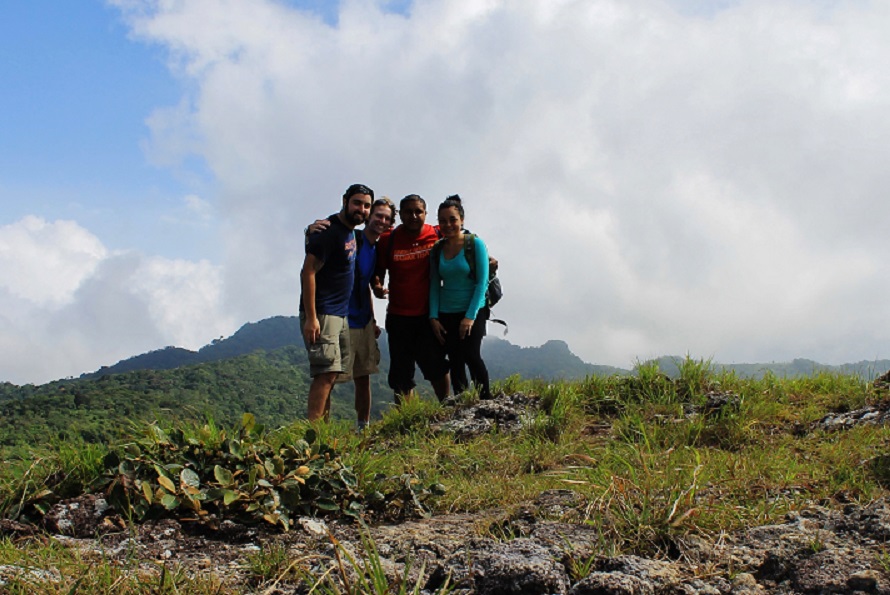
Armed with some GPS coordinates, batteries, fresh SD cards and rough information about the audio logger’s location from a member of the last group who placed it, we headed up the mountain to start our journey. As we began to climb, the heat and humidity was intense — our clothes were soaked in less than an hour.  Large biting ants were swarming our boots as the incline steepened, and we came to a crossroads in the trail. We had reached the GPS coordinates but realized that these coordinates could not be correct. At this point, we decided to attempt to leave the trail and start climbing up what seemed like a cut in the dense jungle, which may have been caused by mudslides and heavy rains, certainly nothing even resembling an actual trail. The going was difficult as the clouds began to gather. Buckets of heavy rain soon began dumping on us, causing the mud to loosen and give, making the more vertical sections especially precarious. In addition to watching your footing in the jungles of Panama, it is also important to watch where you put your hands. Eyelash vipers and stinging insects of all kinds tend to rest on branches and sticks at about eye level. All of these thoughts were keeping our senses sharp as we broke through clearing after clearing, each time hoping that this was the top of the mountain and the audio logger would appear like a shining beacon amongst the dense jungle. Yet, each time the clearings revealed even more vertical walls of vines and thick jungle vegetation to climb. Our resolve was fading, but we pressed on. At one point, my balance gave way, and I fell face first into the side of the muddy slope. As I raised my head, I noticed I was face to face with a tiny gem of a frog. It was a blue-bellied poison frog (Adinobates minutus). This toxic little frog was just staring back at me, probably wondering why a silly, hairless ape had bothered to climb this far up a mountain during a thunderstorm. 

A rainforest rocket frog was identified in the area.

The rain was finally letting up, and this gave us a little boost as we could see some sunshine emanating from what looked like a break in the jungle ahead. As we approached, sharp painful sensations started overwhelming my hands and wrists. We were wading through a large column of sharp bladed grass, which when brushed against, caused a paper cut like lacerations on the skin. Once we emerged from the brush and into the clearing, we realized we had reached the top. The jungle was so dense there was no real spot to even look out to enjoy the view. We immediately got to work searching for the audio logger.  I looked left then right and passed through some thick brush. Then I saw it — a strip of white that stood out in the landscape of green. It was one of the zip ties used to attach the logger to the tree. We had found it! After several minutes of exulted celebrations and numerous high fives, we swapped out the SD cards and batteries, the unit was reprogrammed, and we locked up the protective case. The trip down was more like a ride down a luge course made of mud. This did make the process faster but certainly not any safer. 

Once we finally arrived back at the EVACC grounds, we were exhausted and coated in mud and insect bites but satisfied and content that we had achieved a seemingly insurmountable challenge. After a shower and a cold beverage, I walked out into the moonlight on the grounds of EVACC. Once again, the clouds were beginning to gather around the El Valle mountains, and my eyes settled on the tips of those green jungle peaks, wondering if the logger we had reset for another four months would record a sound of hope.

Learn more about the EVACC foundation and make a donation online to help them ensure the survival of Panamanian amphibian species for generations to come.

Mark Vassallo is pictured with an audio logger.

Amphibian Conservation: Saving the Panamanian Golden Frog

The Panamanian golden frog (Atelopus zeteki) is a unique and beautiful amphibian from the highlands of Panama. This yellow or orange and black “frog” is actually a type of toad that walks more than it hops. It resides in areas near fast-moving streams and rivers in the mountainous forests within the country. The International Union for Conservation of Nature (IUCN) lists the Panamanian golden frog as Critically Endangered, which is one step before becoming Extinct.

In the wild they are believed to be in such low numbers that they may no longer be able to sustain as a wild population; in fact, no one has seen a Panamanian golden frog in the wild for quite some time. Massive population decreases are believed to be caused by chytrid fungus, habitat destruction, the exotic animal trade and sedimentation of egg-laying sites in rivers and streams. Now, they exist mostly in captive zoo breeding populations.

One of these breeding populations has been housed in a bio-secure room at the Detroit Zoo’s National Amphibian Conservation Center for 16 years, and has contributed several years of offspring to the Panamanian Golden Frog Species Survival Plan (SSP). SSPs are cooperative management programs through the Association of Zoos & Aquariums (AZA) that aim to reproduce, genetically manage and possibly reintroduce endangered animals into the wild with the assistance of other wildlife management organizations. In addition to its active role in the SSP, the Detroit Zoological Society (DZS) employs several other strategies to conserve the Panamanian golden frog in the wild. At this time, there is nowhere identified in the wilds of Panama to safely release captive-bred tadpole or juvenile golden frogs to the wild.

Breeding the Panamanian golden frog in captivity involves understanding the complex conditions found in their wild habitat. They have an interesting life cycle from courtship to final metamorphosis. In the wild, males of this species will perch on rock outcroppings or on top of large leaves that overhang or are near a flowing stream or river. The males then begin to call, thrusting out the vocal sacs on their throats as they produce a low trill vocalization meant to alert females to their presence as well as warn other males to stay away. Since these animals breed and live in close proximity to the loud sound of rushing water, their low-toned vocalizations can be very difficult to hear. For this reason, golden frogs have evolved a type of sign language they can use to communicate to mates as well as rivals. These amphibians have the ability to execute a “wave” using their front legs to take the place of their hard-to-hear vocalization when conditions around the stream are noisy. This type of communication is known as semaphore behavior.

Once a pair of golden frogs has successfully mated in the wild, the female will deposit up to several thousand small round white eggs underneath a rock in a steam or river and away from direct sunlight. This is done because the white eggs lack pigment entirely and would be adversely harmed by the ultra violet (UV) radiation from the sun. This same issue has to be addressed at the Detroit Zoo. The animals are bred inside aquariums in a specially modified room just for this species. After the breeding pairs are chosen for the year, the animals are placed together in an aquarium. Prior to the onset of the “wet season,” misting cycles within the frogs’ habitat are coordinated to simulate the “dry season,” giving the frogs a sense of seasonality, which helps stimulate them to breed. If eggs are laid in the aquarium, amphibian staff must protect the eggs from the naturalistic UV lighting over the breeding tanks by wrapping black trash bags around the aquarium. This simulates total darkness, which allows the light-sensitive eggs to develop unharmed. Once eggs develop pigment, the trash bags can be removed.

Eventually, the eggs develop and a small black and yellow tadpole emerges from the egg casing. These tadpoles are very well adapted to living in fast, flowing stream environments with strong mouthparts which assist them in clinging to the rocks in turbulent water as they scrape away at algae and the microorganisms they depend on for food. At the Detroit Zoo, we reproduce the golden frog food source by smearing a wet algae mix on small plastic food plates and allowing the mixture to dry. Once the algae is dry, the plates are placed in the water and the tadpoles move over and around the plate, scraping off the food with their specialized mouthpart. After several weeks, the tadpoles metamorphose into fully formed little toadlets, which are turquoise green and black in color, a color phase that camouflages them in while living in a forest habitat. They eventually turn mostly yellow or orange and black upon reaching adulthood.

Along with the extensive breeding program, conserving the Panamanian golden frog involves reaching out to the communities where these animals live and educating the public. In 2015, I assisted the staff at a small conservation center in El Valle, Panama, called the El Valle Amphibian Conservation Center (EVACC). This center is dedicated to breeding, exhibiting and educating the public on Panama’s native amphibians. While in Panama, I assisted EVACC with their amphibian exhibits and breeding programs. The DZS is also becoming involved in developing educational materials to better educate an already sympathetic public about conserving their environment and this important amphibian. Recently, DZS Curator of Education Claire Lannoye-Hall has been appointed as the SSP Education Advisor for the Panamanian Golden Frog SSP. Within this role, the Detroit Zoo will be instrumental in developing educational programs and cultural awareness within Panama.

The Panamanian golden frog holds a special place in the Panamanian culture. Signifying good luck, the golden frog can be seen on lottery tickets and in gift shops all around the country. The history of this little amphibian within Panama can be illustrated by the presence of “rana dorada” or golden frog, in some of the petroglyphs within the country dating back to pre-European contact. Perhaps those ancient artists were hoping for a little luck as they etched images of this mystical amphibian into the rocks of the cloud forest. Hopefully, with a little of that same luck and continued dedication from the Detroit Zoological Society and its conservation partners, the Panamanian golden frog will not disappear from history for good.

– Mark Vassallo is an amphibian department zookeeper for the Detroit Zoological Society, and works in the National Amphibian Conservation Center at the Detroit Zoo.

Notes from the Field: Two Weeks in the Panamanian Jungle

Recently, I found myself trekking through the jungle, holding a machete, in search of the perfect piece of wood. This wasn’t a typical day of work for me with the Detroit Zoological Society (DZS) – I’m usually found in the National Amphibian Conservation Center (NACC) at the Detroit Zoo, changing filters, cleaning misting lines and feeding tadpoles. But on this particular day, I was in El Valle, Panama, a small town situated in the valley of an extinct volcano; the historic home to the Panamanian golden frog (Atelopus zeteki), a species that is critically endangered in the wild.

The DZS has maintained a breeding population of Panamanian golden frogs at the NACC since the year 2000 as part of the Association of Zoos and Aquariums’ Species Survival Plan, a cooperative management program that ensures genetically healthy, diverse and self-sustaining populations of threatened and endangered species. Since I personally care for and breed this delicate species at the Detroit Zoo, it was truly awe-inspiring for me to travel to Panama; to see and experience the tropical cloud forest habitat that was home to the golden frog until the late 1950s, when the last sightings were reported in the area.

Like many amphibian population declines worldwide, the threat to the Panamanian golden frog is a multi-pronged, human-induced sucker punch of climate change, de-forestation and over-collection for the pet trade. Also, a very serious parasitic fungus known as Batrachochytrium dendrobatidis or “chytrid Bd” [ki-trid] became present in the area. This fungus thrives in the environment of a cloud forest and caused a dramatic decline in amphibians through the region.

Despite the thrill of viewing some amazing wildlife on our walk through the Panamanian jungle, I wasn’t there to enjoy the scenery. My purpose in traveling to El Valle was to assist the limited staff at the El Valle Amphibian Conservation Center (EVACC), a small conservation center dedicated to breeding and researching the country’s most endangered amphibians, as well as educating the community in Panama about the amphibians in the area.

For two weeks, I trained the staff at EVACC on habitat design and maintenance. I shared techniques for designing water features, drilling enclosures for bulkhead placement and “propping” habitats – gathering supplies like logs, plants and rocks to create a naturalistic environment. One day was dedicated to removing and replacing an old “roof ” of a habitat planned for golden frogs, which was the size of a living room. Other days involved finding things like sticks, logs and foliage to prop the habitats, and since all of the animals were from the surrounding area, most of what we were collecting could be found and disinfected within the grounds of the conservation center.

The EVACC’s newly designed habitats would be playing an important role in the “Golden Frog Day” in El Valle, a celebration of the magical amphibian that once lived and thrived among the misty forests of the mountains. Without public support in its country of origin, there could be no future for this animal. With newly renovated habitats and the beauty of this vibrantly colored amphibian, visitors to the center can begin to understand the value of this species and the power it holds as members of the community work to conserve it.

A true reward for all of this hard work and training came several days after leaving Panama, when I received an email from EVACC staff informing me that they had drilled their first tank and were using techniques that I taught them to install a new waterfall feature. While I had ditched my machete and my head lamp, no longer needing to trek into the jungle for my work with the Panamanian golden frogs at the Detroit Zoo, I know that the work we are doing some 4,000 miles away from their home is just as critical to the survival of this incredible species.

– Mark Vassallo is an amphibian department zookeeper for the Detroit Zoological Society.