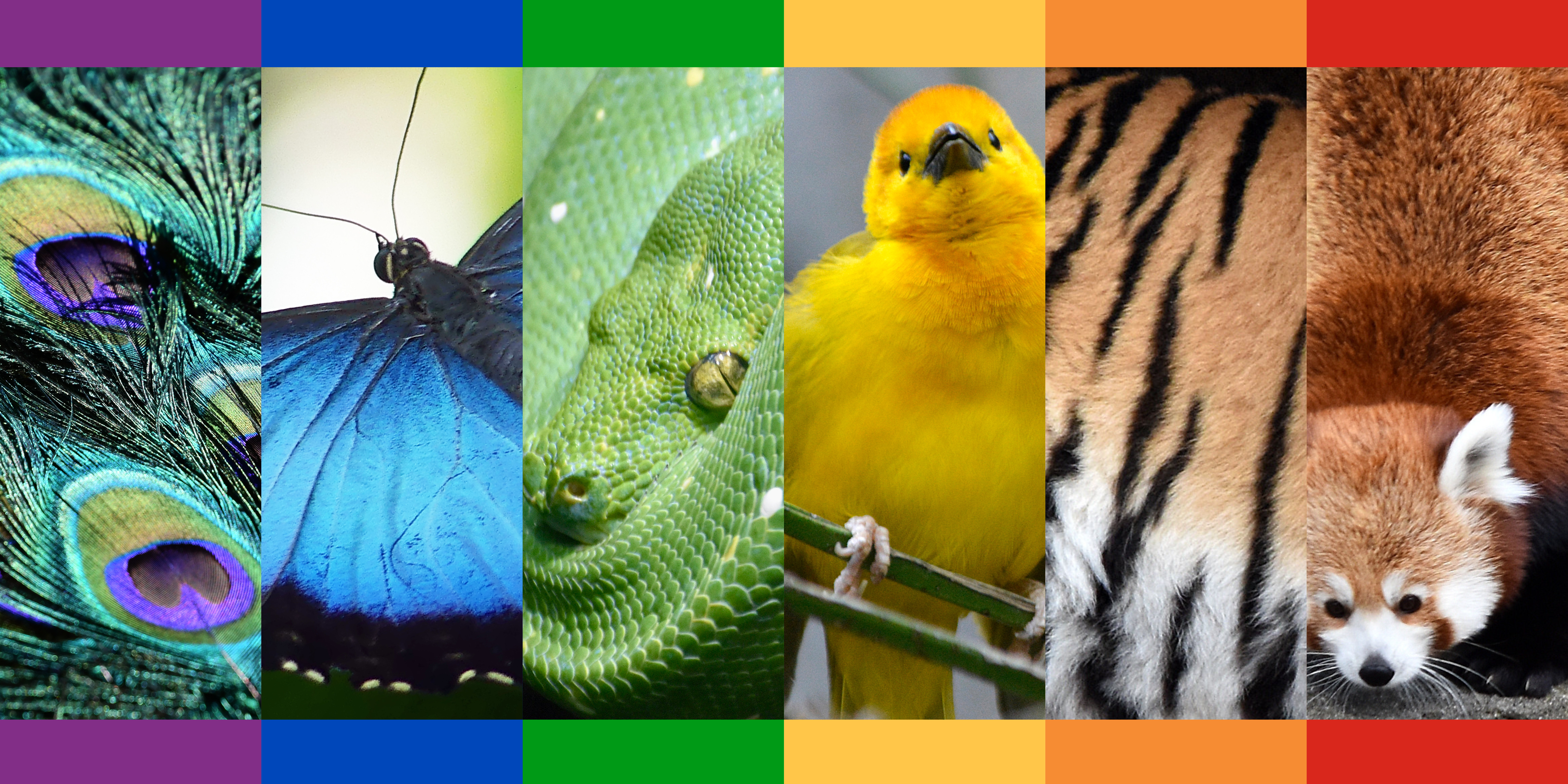
In celebration of Pride Month, we would like to share a colorful exploration of diversity within the animal kingdom.
A Sparrow With Four Sexes
White-throated sparrows have displayed a fascinating mating system that consists of four sexes. This species is comprised of two distinctive phenotypes: white-striped and tan-striped crown. What makes these birds so interesting is that several genes have been identified and have a direct relationship to their behaviors. White-striped crowns seek multiple partners and invest heavily in securing additional matings at the expense of paternal care. Alternatively, tan-striped males are monogamous and contribute more to parental care. The white and tan versions are genetically determined. White-striped sparrows have an inverted section of chromosome 2, which effectively acts as a second sex chromosome and leads to white-throated sparrows having four sexes. About 98 percent of observed pairings (mated or social) exclusively pair with the opposite phenotype. Because these birds have been observed to only mate with one-quarter of its species, it can be considered that they act as if they have four sexes.
The Fluidity of Fish
Sex-determination mechanisms are particularly diverse in fish and include many species in which changing sex at least once is a normal and adaptive feature of the fish’s biology. Researchers call this “sequential hermaphroditism” and have documented fish species that change from female to male (protogyny), species that change from male to female (protandry), and species that can change back and forth repeatedly throughout their lifetimes. All these systems have adaptive advantages suited to the fish’s particular environment.
Mom’s Got it Covered
Several lizard species have evolved into all-female unisexual species that reproduce asexually through a process called parthenogenesis, which is essentially cloning. Same-sex courtship and reproductive behavior, generally referred to as “pseudocopulation” by researchers, occurs between females of the exclusively female unisexual whiptail lizard. This behavior increases their ability to reproduce by stimulating ovulation. Research on wild populations of unisexual whiptail lizards found strong evidence that same-sex pseudocopulation between females is not only beneficial to their reproductive success but is the norm for this species and practiced as regularly as copulation in sexual species. Through hormone-mediated processes, about half of the unisexual lizards in an area assume the behavioral role of “males” in these reproductive interactions, then later switch roles.
Sources:
Tuttle E., 2016, Current Biology 26, Divergence and Functional Degradation of a Sex Chromosome-like Supergene
Hedrick P., 2018, Negative-Assortative Mating in the White-Throated Sparrow. Journal of Heredity, Vol. 109, No. 3
ArnoldC., 2016, Nature volume 539, The Sparrow with Four Sexes
Crews D., Grassman M., Lindzey J., 1986, Proc.Natl. Acad. Sci. USA, Vol. 83, Behavioral facilitation of reproduction in sexual and unisexual whiptail lizards
Crews D., Young L., 1991, Pseudocopulation in nature in a unisexual whiptail lizard. Article in Animal Behavior
Woolley S. C., Sakata T. J., and Crews D. 2004, Tracing the Evolution of Brain and Behavior Using Two Related Species of Whiptail Lizards: Cnemidophorus uniparens and Cnemidophorus inornatus. ILAR Journal
By Melissa Thueme, primate supervisor for the Detroit Zoological Society (DZS)
In 2022, the DZS introduced a new program to staff, the Conservation Action for a Resilient Environment (CARE) grant. The CARE grant program at the Detroit Zoo offers the opportunity for employees to engage in conservation projects that are meaningful to them while addressing conservation and environmental issues in the Detroit metro area and the Great Lakes region. When the grant program was announced in early June, I knew exactly what I wanted my project to be. Just three weeks earlier, a large wildfire devastated northern Michigan, and I knew I could help rebuild some of what was lost there.
Pigeon River Country State Forest (PRC) in Montmorency County, Michigan, the largest block of undeveloped land in the Lower Peninsula, is home to diverse wildlife, including one of the largest elk herds east of the Mississippi. In May 2022, a wildfire caused by a lightning strike impacted 2,516 acres of forest in the PRC. Because of the intensity of the fire, a majority of the trees in the fire zone did not survive. The flames and resulting heat damaged many of the soft mast trees, including trees that produce berries such as apple and hawthorn and younger-aged hard mast that provide food sources such as nuts and acorns. Many native wildlife, such as deer, elk, black bear, squirrels and game birds, rely on both hard and soft mast trees for food.
My passion for involvement in this grant project goes back almost 30 years. Since I was young, my family would drive north to Pigeon River State Forest to go camping for a week during the summer. It was in the PRC that I fell in love with nature, animals and the environment. We got up before sunrise to drive through the most remote areas in search of any animals we could spot. I learned about the elk herd, watched birds through binoculars, looked for frogs at the edges of the lakes, waited for the beavers to swim by in the river, and reclined and watched the stars in the black sky at night. A few years later, my family bought property in the area, and we went up north many weekends from spring to fall, spending holidays and making more memories in the PRC.
In May 2022, we watched news coverage of the fire as it swept through the area. We monitored updates as the area we loved was in flames, without knowing how much damage would occur. Thankfully, DNR firefighters were able to extinguish the wildfire, now named the “Blue Lakes Fire.” I visited the PRC the weekend following the wildfire. As I walked down the road, the transition between the lush forest to the now barren burned areas was dramatic. Places where it had been impossible to see more than a few feet through the foliage were now nearly clear — except for a few char-barked trees trying to hang on to life. Memories of hiking and blueberry picking, and large herds of bull elk standing in these very areas, flooded back. I wondered what the future would bring for this area and how long it would take to recover. In our many years of visiting, we had seen areas of wildfire in the PRC before, but nothing to this magnitude. The devastation from the wildfire was still fresh in my mind when the call for proposals for CARE grants was announced. I knew this was a project that I wanted to pursue and something I was strongly passionate about.
I reached out to the Pigeon River Forest Management Group of the Michigan Department of Natural Resources (DNR) with my idea for the grant project, and their team was eager to collaborate. With the help of Mark Monroe, the PRC forest manager, and Shelby Adams, the PRC wildlife biologist, we started planning what would best be suited for the project. After many phone and Zoom calls, we elected to plant saplings in the wildfire area. The team carefully selected trees that would most benefit the environment and the animals and mapped out the section where we would plant them. The Pigeon River Forest is important to many people, and collaboration is one of the pillars of the DZS conservation strategy, so we decided to involve the community in the project.
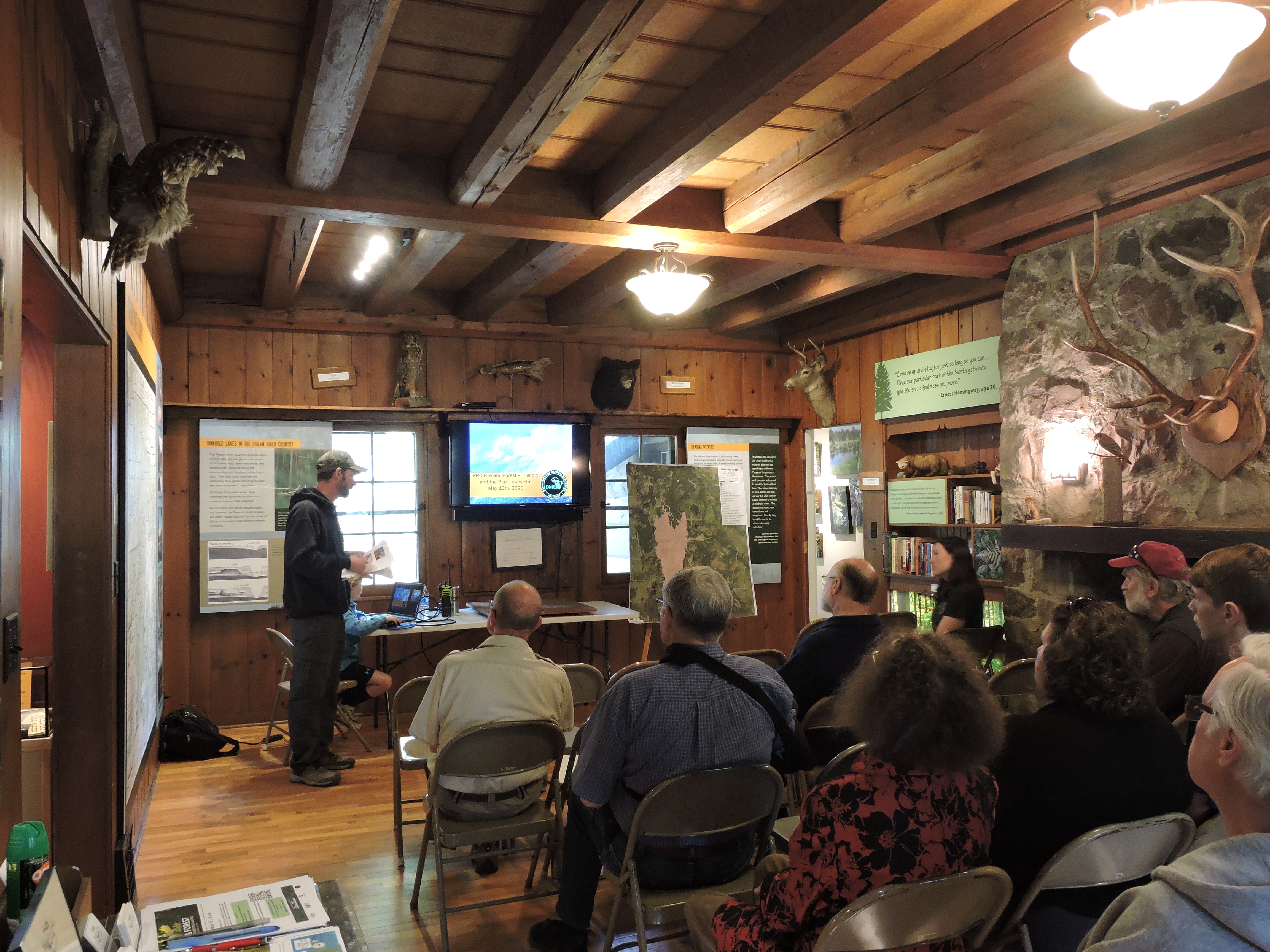
On May 13, 2023, one year after the wildfires, we gathered together in the Pigeon River Discovery Center with members of the community and others who had a connection to the PRC. Mark, also a firefighter with the DNR, was on the front lines the day of the wildfire. He spoke about fire history in the PRC, shared photos and his stories from the days around the fire. Shelby talked about the effects of wildfires on wildlife, including some of the positives, such as the creation of a prime habitat for the Kirkland’s warbler, which thrives in young jack pine forests that grow because of fire. Lastly, I spoke about the Detroit Zoo CARE grant, as well as my connection to the PRC. Everyone loaded up on Smokey the Bear swag items — pencils, stickers, magnets — before going outside to meet some of the other DNR firefighters and explore the equipment used in wildfires. Then we headed to the planting site.
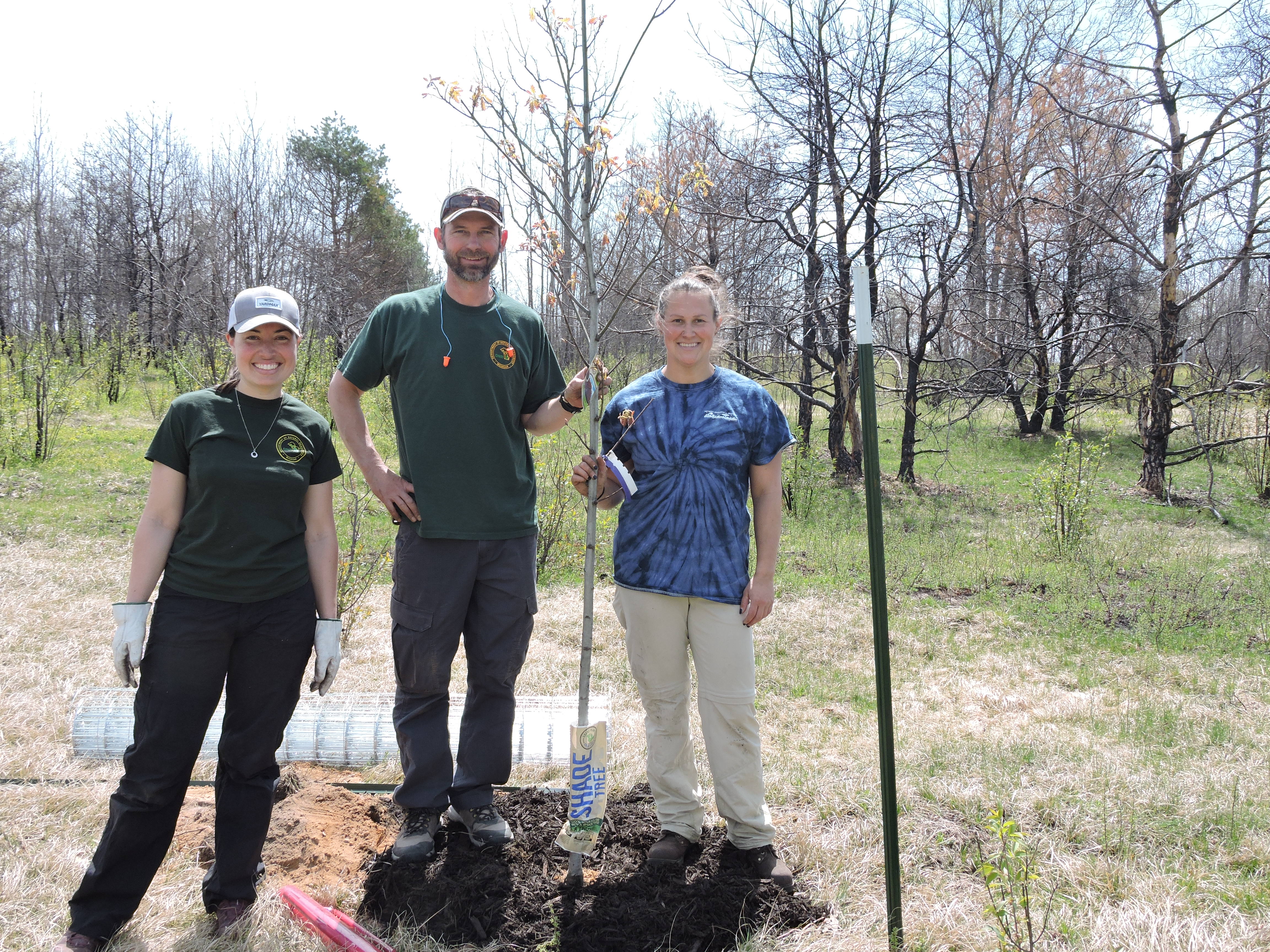
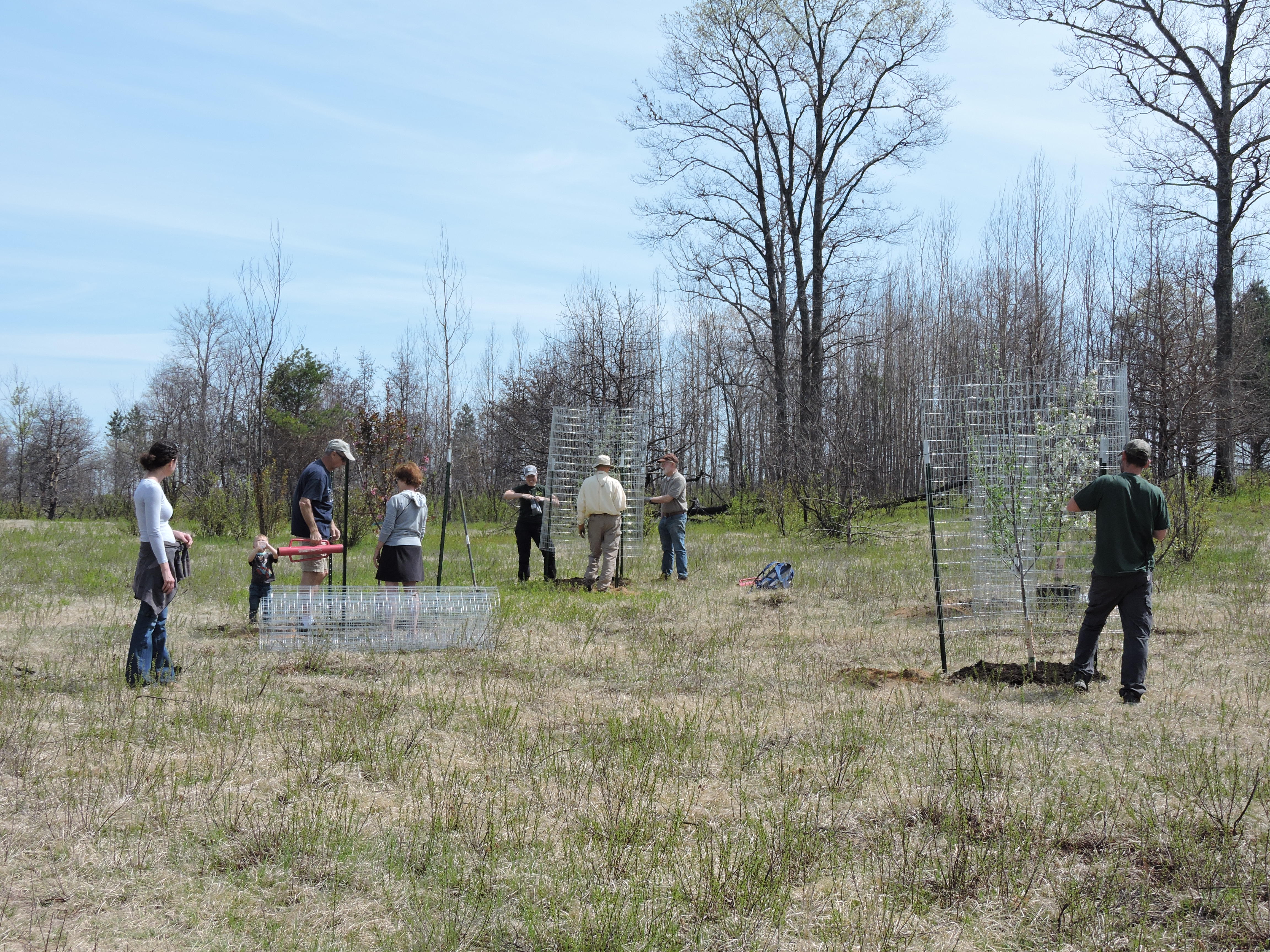
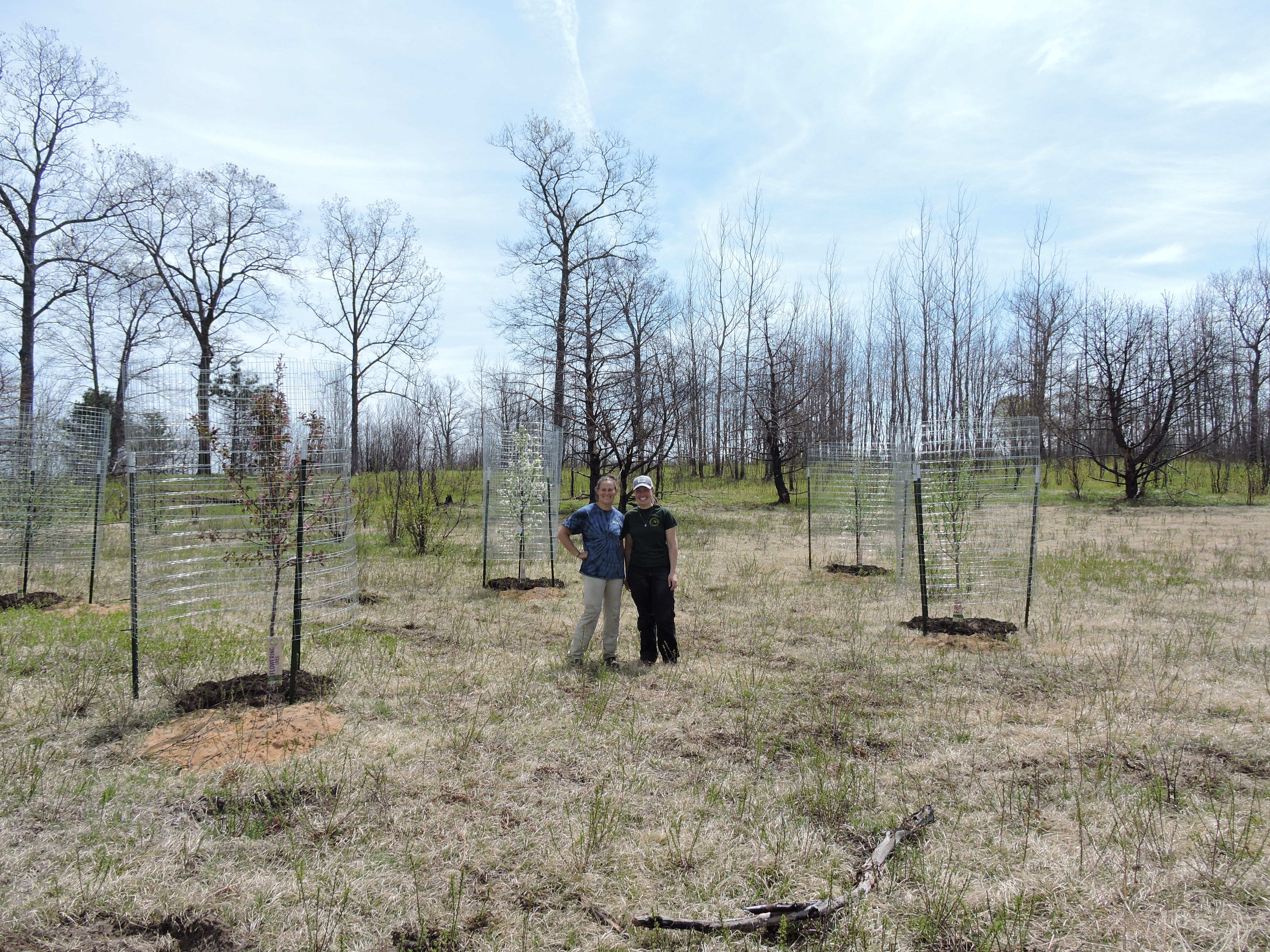
Participants divided up into a few teams and spread out amongst the pre-drilled holes. Mark gave a demonstration of how to set up the trees and everyone got to work. We planted a total of 20 trees in four sections, surrounded them with mulch and fencing to protect them until more established. While the volunteers worked, they shared memories of their favorite experiences in the PRC and thanked us for doing the project and letting them be involved. As we parted ways, I stood back and looked at the trees we planted amongst the low grasses starting to regenerate. It felt good to be a part of something to give back to the forest which has given me so much. I hope that 30 years from now, another young girl is hiking through the Blue Lakes area past these now-mature trees and finds herself just as inspired as I was all those years ago.
By Claire Lannoye-Hall, director of education for the Detroit Zoological Society (DZS).
Follow Claire on her journey through Peru when you read this blog on StoryMaps!
For more than two decades, the DZS has partnered with CONAPAC, a nonprofit organization in the heart of the Peruvian Amazon Rainforest. With the generous support of Amazon Explorama Lodges, a travel company with more than 50 years of commitment to the region, the partnership supports the conservation of this globally essential ecosystem. Each year, thousands of students and teachers receive school supplies, teachers participate in professional development workshops, and families have access to clean, safe drinking water.
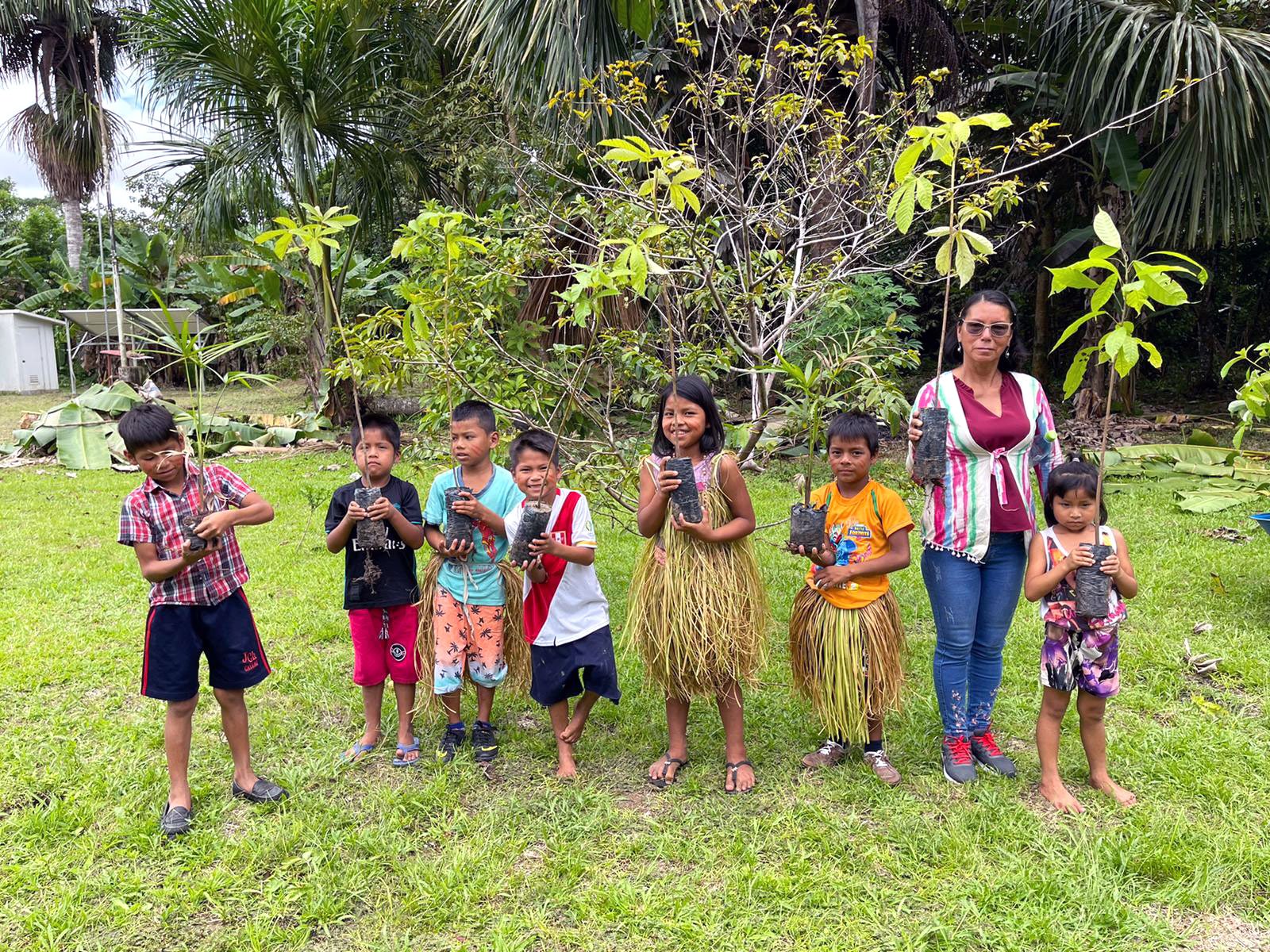
In addition to the partnership’s commitment to education and safe drinking water, we support economic opportunities for interested communities. As part of this initiative, several thousand fruit trees have been planted in select communities as a source of added nutrition for families. As the trees mature and produce excess harvest, fruits are sold as a source of income.
During the first week of December 2023, four team members from the Detroit Zoo traveled down to Peru to participate in fruit tree planting. The Fruit Tree Planting Foundation provided funding for fruit trees that are native to the Amazon rainforest to be grown and transported. Pedro Paurcarcaja, an arborist in Iquitos, Peru, grew the trees from cuttings and seeds. Each tree was cared for and allowed to grow to a size that could be successfully transplanted. The trees were then placed in crates by type and transported down the Amazon and Napo Rivers on a cargo barge. Thousands of trees were delivered to the designated communities.
Each morning, we joined a group of volunteers and representatives from the Fruit Tree Planting Foundation, CONAPAC staff and an experienced guide and translator from Explorama. We all took a boat to reach the designated community. Some of the trees went to individual families who expressed their interest and commitment to growing trees on land they have available. The families were responsible for planting their trees. Several hundred additional trees were planted in community spaces and for the schools.
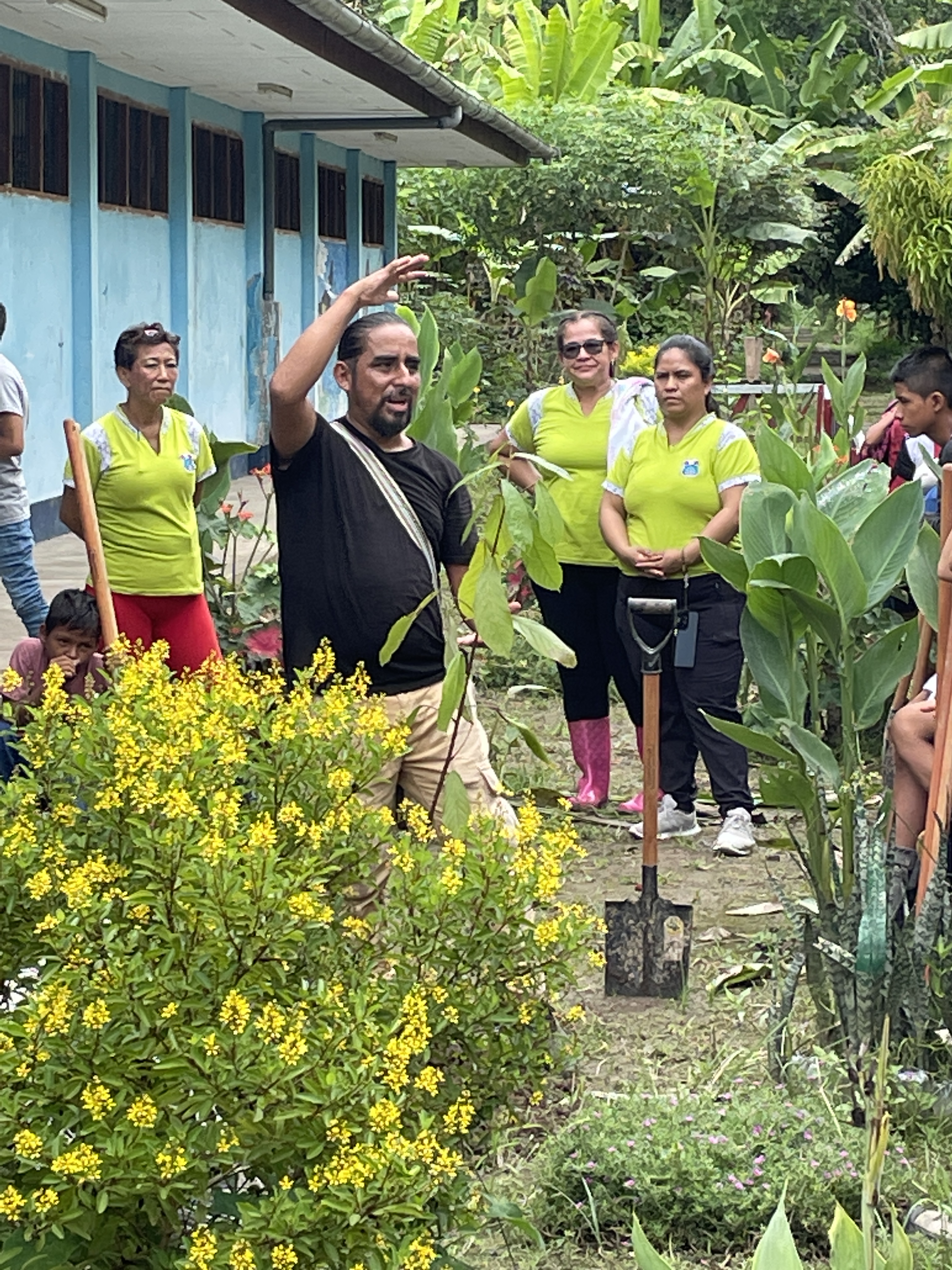
Before our arrival, the communities prepared areas previously used for agriculture, such as corn and banana palms. With shovels and post-hole diggers in hand, the FTPF representative carefully demonstrated how to plant the saplings to ensure they had the best chance of surviving. We worked alongside members of the community, especially the children, and planted the trees designated for the community and school areas. The planting wrapped up each morning shortly before lunchtime. Spending several hours at each community provided opportunities to learn each other’s names, communicate in various forms (even if it was just smiles!), and gain a glimpse into the day-to-day life of our partners.
For the final two days, we visited an additional community in the afternoon. Both communities planted trees several years ago through the FTPF initiative and proudly showed us the trees’ growth. Ramon Castilla shared with us that more than 90 percent of their trees had survived, which is an impressive feat considering the risk of insect and flooding damage. Their success was a testament to the trees being planted in the right areas and their commitment to caring for them. The community of Jorge Chavez treated us to fruit fresh off the trees, including papaya and star fruit.
The community visits were also an opportunity to check in on the water purification systems, ensuring things were working correctly and the communities had access to safe, clean drinking water. For more information about CONAPAC’s clean water programming, click here.
Conservation work, especially when conducted in international settings, often does not address the needs or fundamental rights of the people who are directly impacted by laws and regulations that are put in place in the spirit of protecting animals and natural resources. While time-consuming, building meaningful relationships with individuals and communities who live adjacent to or share the same space as essential conservation areas can create vitally important allies. To do this well takes time and an investment in the wealth of knowledge and expertise of individuals who have lived for generations in the conservation areas. This partnership exemplifies the benefits of what collaborative conservation can accomplish.
To contribute to the vital conservation work in the Amazon rainforest, click here.
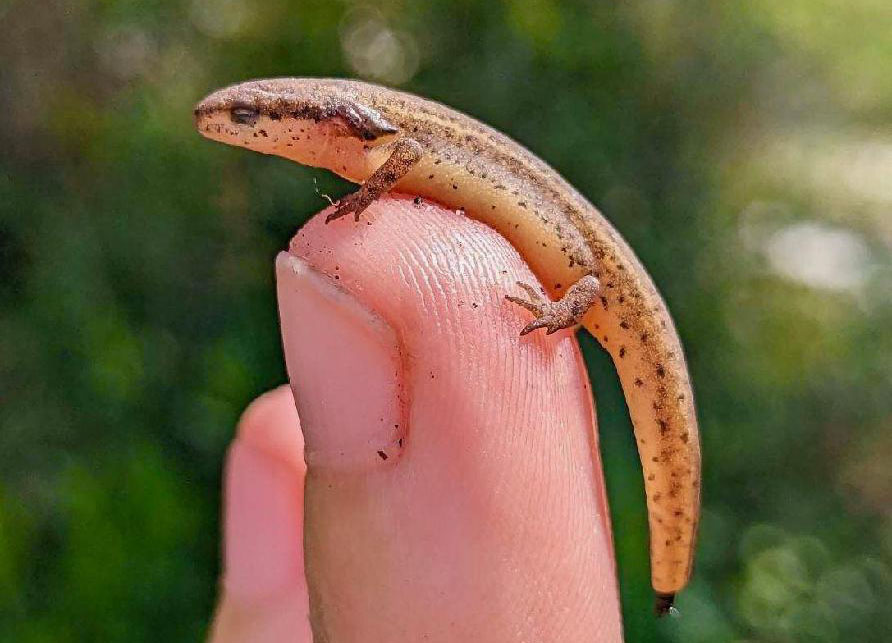
It’s just before dawn in the Apalachicola National Forest of Northern Florida, and light is glinting off the dew of the long-leaf pine trees as the humidity peaks. These conditions are just right for one of nature’s most adaptable animals to undertake an incredible journey. A striped newt (Notophalmus perstriatus) stirs under the water of a temporary pond.
Today, this young newt is preparing to travel from the relative safety of this ephemeral pond, to which he has been introduced with the help of the Coastal Plains Institute (CPI) and the Detroit Zoological Society (DZS). CPI has been dedicated to preserving the long-leaf pine ecosystem since 1984 and continues to work to maintain this unique habitat through scientific research, land management, and environmental education within Florida. The striped newt, recently listed as “threatened” in Florida, needs all the help it can get.
This very pond where the newt plans to emerge has been constructed and maintained through the work of CPI. The DZS and CPI have been collaborating on releases such as this one since 2017, and this particular newt has been bred and raised at the Detroit Zoo by staff who specialize in amphibian care with this moment in mind, the opportunity to re-introduce species and preserve biodiversity.
Newts are raised at The Detroit Zoo.
The striped newt can adapt to life outside the water, an ability that amphibians have been perfecting for millions of years. When conditions are right, the striped newt’s skin will begin to thicken and granularize, helping to hold moisture more efficiently than its typically slippery and smooth skin. The newt’s tail will become narrow, round, and less like a paddle, making traveling over dry ground much more efficient. This life stage is known as an “eft.”
As the newt slips out from under the water and moves onto land, its bright skin coloration advertises its toxicity to any potential predators who wouldn’t mind getting an early morning snack. Moving deliberately through the ground cover, the newt encounters a drift fence and travels along the edge of it. After a few feet, it drops into a 5-gallon bucket, which CPI staff soon recovers and processes. This fence and the corresponding bucket are all part of a scientific study undertaken by CPI to measure the success of introductions such as this one. Monitoring these drift fence arrays is no easy task, and CPI volunteers are tasked with checking these traps every day for up to seven months of the year.
Many months ago, the amphibian care staff at the DZS’s National Amphibian Conservation Center (NACC) began preparing to breed our resident population of striped newts. All the conditions for reproduction had to be just right. The correct water quality, depth, and egg-laying materials were painstakingly researched and implemented. With the addition of a specialized water filtration system, known as a reverse osmosis system, the amphibian department staff had complete control over the “makeup” of the newt’s water. It could reach the correct parameters to mimic the natural environment where these newts live in the ephemeral wetlands of Florida and Georgia. The plumbing required for this filtration unit was installed and tested by the DZS’s maintenance staff. The work required careful drilling through the walls of the NACC to run plastic plumbing lines to deliver the filtered water to the bio-secure and husbandry spaces where animals are kept. This was no small feat and proved to be a great example of how the DZS’s conservation success is a team effort spanning all the departments of the Zoo.
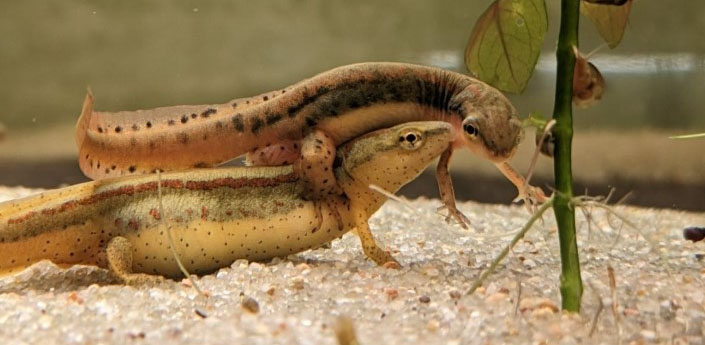
After all this effort to prepare, the real success occurs when the striped newt begins the reproduction process. The male will hold the female in an embrace known as amplexus; during this embrace, the male rubs the female’s snout with his chin and releases pheromones, which are fanned towards the female with his paddled tail. Once the female is receptive, the male will drop what is known as a spermatophore. From this point, the female will accept the spermatophore, and internal fertilization will occur.
Once the eggs are laid, usually on long emergent vegetation that has been placed in the habitats of the striped newts, the baby newts will begin to develop. This process can take several weeks and can be affected by temperature. The larvae are tiny, sometimes measuring about 8 millimeters, and very thin, resembling a small piece of wood or a twig, making them difficult to see with the naked eye. These tiny larvae are fed small invertebrates and aquatic worms, which have also been cultivated by the talented staff at the NACC. Once the newts have reached about 13 millimeters, they are eligible for release, counted and carefully shipped to Florida when conditions are just right in the wetlands for release.
After a long journey from an egg in the bio-secure breeding room at the NACC to the Florida wetlands, our newt is now being counted and sent into the forest by the staff and volunteers at CPI. This newt will likely spend years in this “eft” life stage, moving through the long-leaf pines and feeding on invertebrates. If conditions are right in the coming years, the newt will be beckoned back to the temporary ponds by rainfall and favorable environmental conditions, where it could potentially breed naturally and help bolster the numbers of this unique and increasingly rare amphibian. In 2023, the DZS and CPI introduced 227 striped newts back into the wilds of Florida, increasing the numbers of this important animal and furthering the case for collaboration in conservation.
Volunteers from Coastal Plains Instituterelease newts into the wild.
The striped newt repatriation project ended the season with a beautiful surprise. Several months ago, CPI staff dip-netted two large, gilled paedomorphs out of the new, rubber liner-enhanced release pond, where CPI staff released 227 young larval striped newts. The newts had been raised here at Detroit Zoo, sent to Florida on July 11, then released on July 12 after an acclimation process. In the coming weeks, four of the 227 were encountered in drift fence buckets and inferred to be exiting the pond and going terrestrial as efts. No others were seen after that. We worried that most animals were lost to predation by turtles and predaceous invertebrates. However, to end the season and ascertain whether some newts had survived and opted to live an aquatic life, CPI captured the two paedomorphs.
These paedomorphic animals may represent a persistent aquatic ‘population’ there. We hope and expect they will go on to reproduce. That will be determined next year by dipnet and drift fence sampling. This is the best news of the 2023 striped newt repatriation project field season and one of the highest points in the 11-year ongoing recovery efforts.
DZS raise newts and prepare them for wild release.
By Mary Humbyrd, coordinator of behavioral husbandry for the Detroit Zoological Society (DZS)
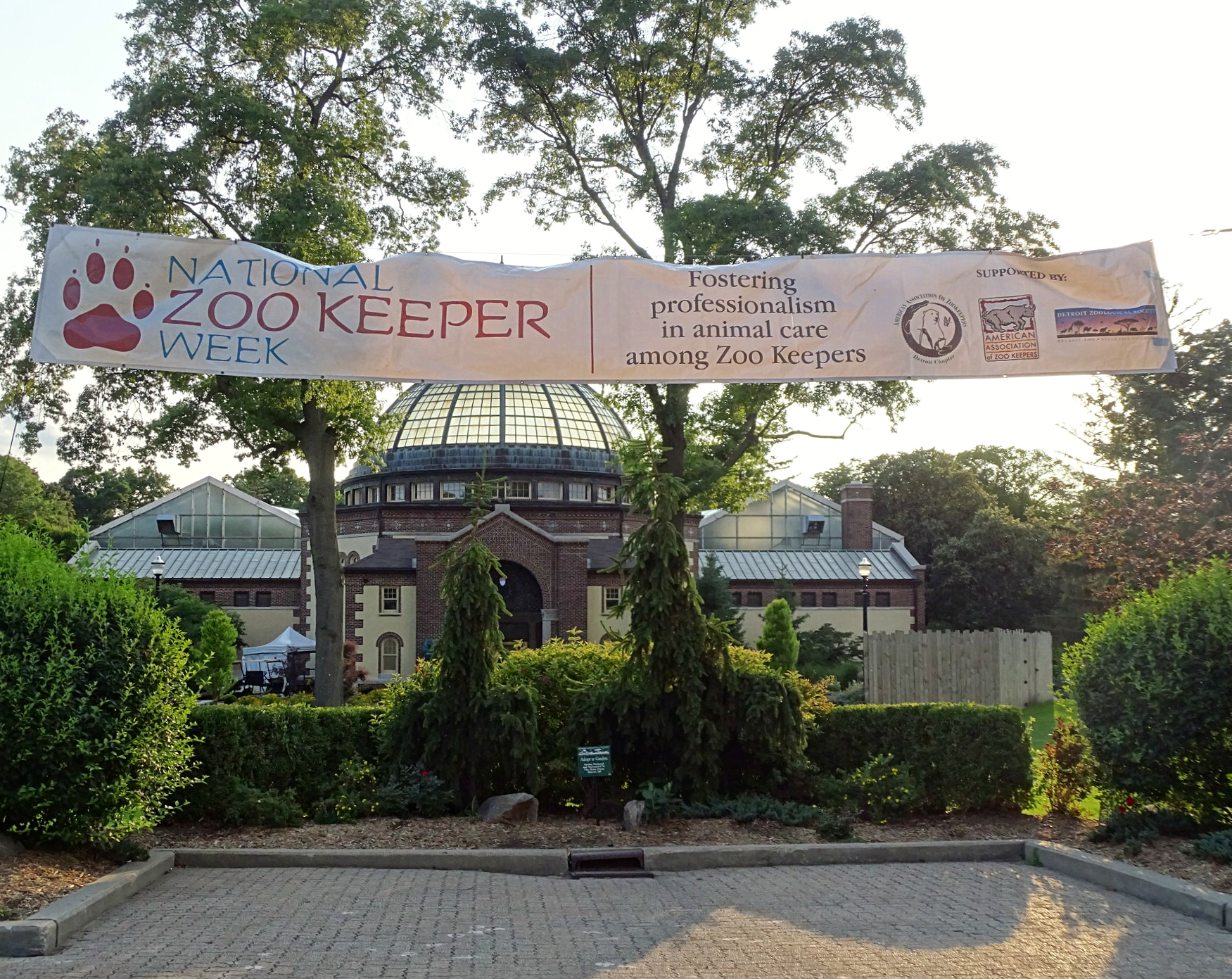
National Zoo Keeper Week starts annually on the third Sunday of July. Representative Susan A. Davis introduced House Resolution 509 on June 21, 2007. This resolution was proposed to encourage individuals on a national level to engage in programs, activities and ceremonies during National Zoo Keeper Week that encourage species conservation and public awareness of the important role of zoos in wildlife conservation.

It is an absolute honor to celebrate our DZS zookeepers. Zookeepers are a unique bunch and have many amazing talents not often seen by zoo guests. Our animal care team is creative, innovative and can build just about anything with some zip ties and duct tape. Zookeepers brave the hottest days of summer and the freezing days of winter. Animal care specialists are on a constant quest for knowledge to improve and raise the bar to provide the best care of the animals they adore. They are involved with the animals from birth to passing and build lifelong relationships. They have their heart and soul in the profession. Zookeepers are advocates, educators, scientists and enjoy sharing their passion with anyone and everyone they encounter. As no day is ever the same, zookeepers have an incredible ability to go with the flow — but with precision and accuracy. Their passion for all living things is inspiring and enlightens all of us who have the privilege of hearing their stories.
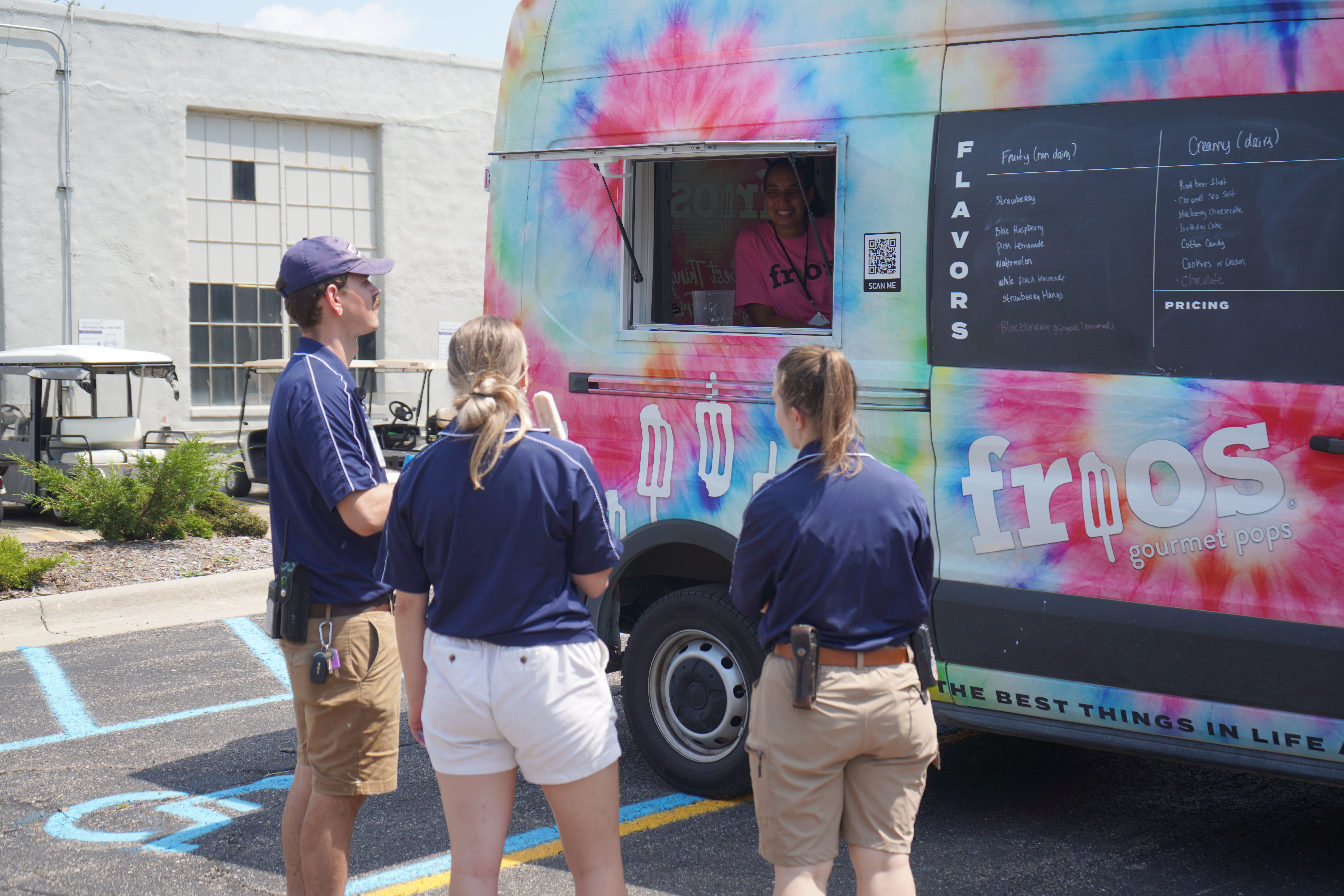
From ice cream socials and cookouts to food trucks and Tigers games, scroll through the gallery below to see how we celebrated the DZS animal care team this past National Zoo Keeper Week!
Authored by Jordan Reichenbach, animal care team member for the Detroit Zoological Society.
When a single sentence about a trip to Peru was uttered in our morning meeting on one gray December morning, I had no idea the kind of incredible things I would experience in the month following because of it. It was pitched to me as a two-week trip to the Peruvian Amazon to set up camera traps for a study looking at small mammal populations. The trip was the culmination of a relationship between the Detroit Zoo and OnePlanet, a nonprofit organization that works with the indigenous Maijuna people in Peru to protect the rainforest and its inhabitants. This was an opportunity I knew I could never pass on — it was the perfect combination of conservation research, language immersion and exceptional collaboration.
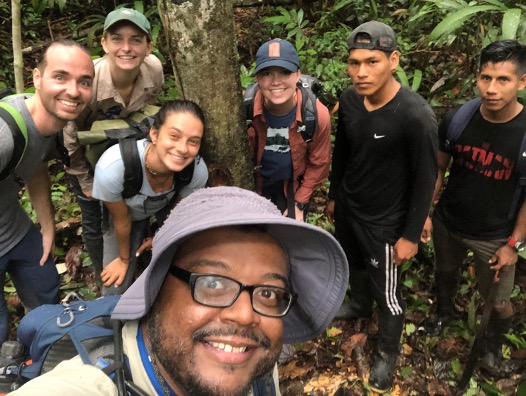
Once I knew I would be going on this trip, the last two weeks of 2022 passed in a blur full of camping supplies, travel doctor appointments and plane tickets as I prepared for our time in the Amazon. The Detroit Zoo sent me, a mammal care specialist, and Thomas Benson, a curator of education, to join a handful of other researchers from OnePlanet. Although Thomas and I had not met before, we found ourselves thrown together before we knew it as we set off on our epic journey into conservation in the heart of the Peruvian Amazon.
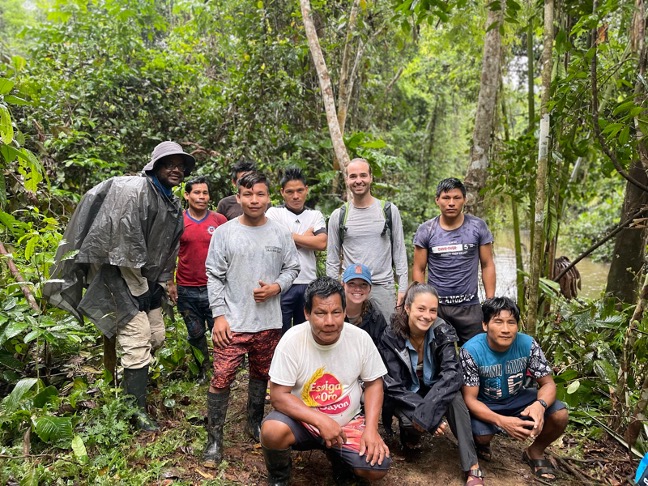
Three planes and a long boat ride later, Thomas and I were introduced to Sucusari, our home base for the next two weeks, set in northeastern Peru. Here, we were also introduced to the research we would be doing and the people we would be working with. The goal for our trip was to set up camera traps throughout this region of the Amazon to monitor game mammal populations and, ultimately, show the sustainable practices of the Maijuna. We would accomplish this goal by working with many Maijuna people who volunteered as forest guides, boat drivers, cooks and more. Our days in Sucusari started at the crack of dawn, sometimes earlier, so we could get a head start on boating to the area we would be camera trapping for the day. From there, we would walk anywhere from 3 to 9 kilometers to find the perfect spots for cameras. These “walks” occasionally turned into wades, or even swims, through flooding areas of the forest. After two weeks, we were able to help set up more than half of the cameras needed for this study. We learned so much more than just how to traverse the jungle and set up cameras, though.
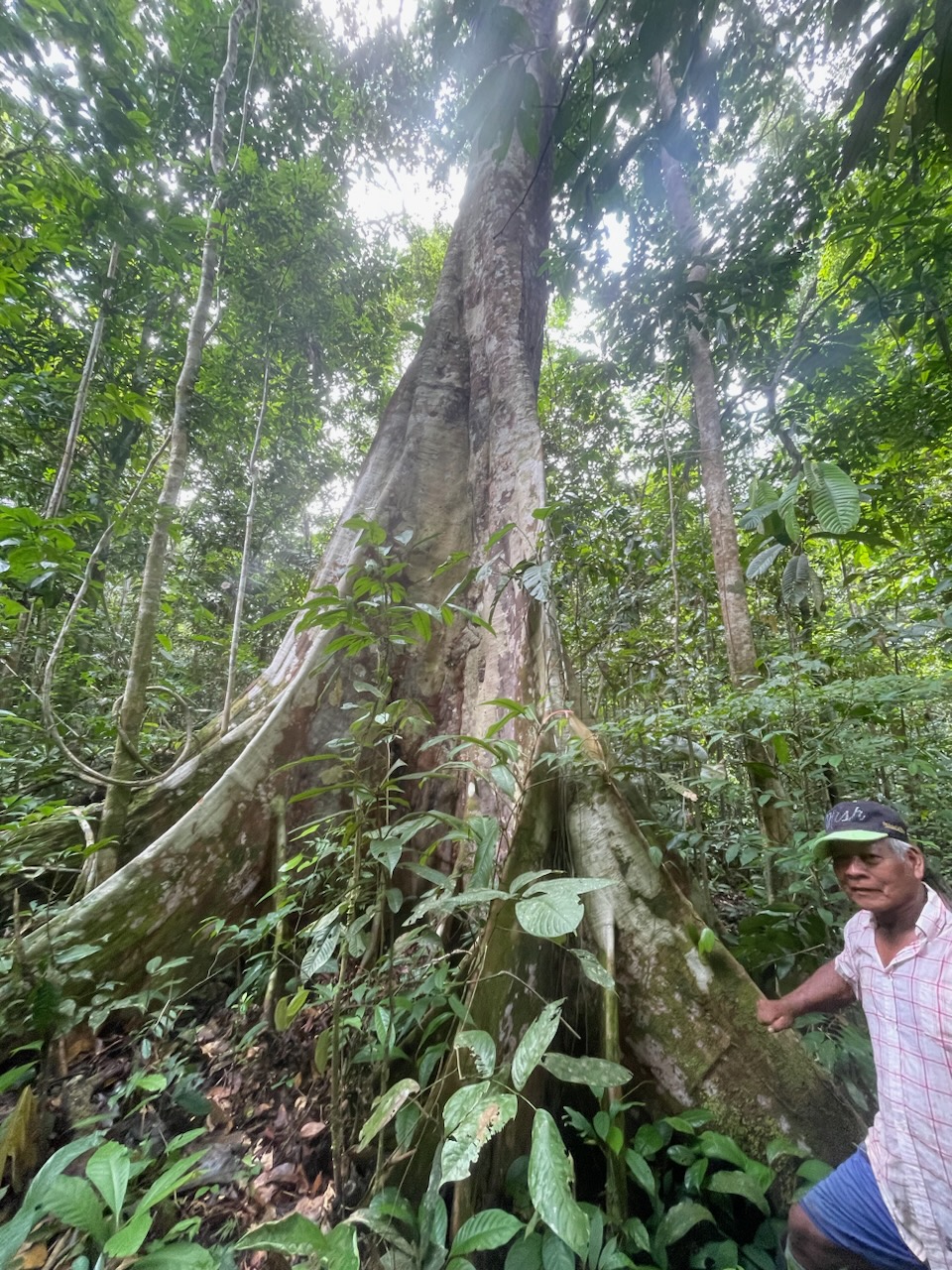
Thomas and I got the privilege of experiencing the beautiful nature of the Peruvian Amazon and learning from the incredible people who call it home. The Maijuna have lived in Sucusari for generations, which shows in their knowledge of and respect for the surrounding Amazon. When they guided us through the jungle day after day, we got to soak in a lot of this knowledge as they would tell us about the flora or fauna we would pass along the way. Nothing could match my astonishment while being able to witness how well they know this forest. We had Maijuna of all ages helping us, with the youngest being just 15 years old. Already, this boy was able to navigate through the jungle and confidently lead us to the perfect camera spots. The elders were also incredible guides because of their vast experience in the Amazon and the stories they could tell us about almost any plant we encountered. For example, we came across many samauma trees that Victorino, a well-respected elder in the community, explained were used for communication on long expeditions in the forest because the roots are hollow and are very loud when you bang on them. Many elders of the community have helped with this camera trapping study, or ones similar in the past, and some of them were even giving us helpful hints on the cameras and where to set them up for the best results.
This relationship between the OnePlanet team and the Maijuna people is built on a trust established over many years of working together and learning from one another. This relationship has benefited and will continue to benefit the Maijuna and their ancestral land. The camera trapping project we worked on will help the Maijuna community by showing people how important and valuable their specific relationship with the Amazon is. The Maijuna hunt for food security and income, but they do so in a way that does not lead to long-term biodiversity loss. The sustainable lifestyle of the Maijuna and how they use the jungle around them is a major reason why the environment thrives. By helping with this study, the Detroit Zoo is supporting the future of the Peruvian Amazon and the Maijuna community.
I also personally learned and grew a lot from my experience in Peru. Not only did I physically push my limits with our jungle treks and long days, but I also mentally tested myself in the best way by working with people who did not speak English and lived a very different life than the one I have known. One of the highlights of this trip for me was having story time with one of the elders, Don Sebastian, who told us Maijuna stories about the origins of specific plants and animals. These tales have been passed down through generations and to hear them told firsthand was moving and awe-inspiring. Another experience I’ll forever look back on is our very first day of camera trapping. On day one in the jungle, we encountered stingless bee colonies, watched squirrel monkeys and black-mantled tamarins leap through the canopy, and even got a classic rainforest shower. These are things that I dreamed about as an animal care staff member and a general biology lover. To see and feel these things with my own eyes was an incredible start to a whole breathtaking adventure.
Although not every day was easy, I’ll savor every moment I spent with the Maijuna and OnePlanet people in Sucusari. I feel so grateful to have gotten the chance to go on this journey, and I hope this inspires people to find out more about the Detroit Zoo and OnePlanet and how they are helping to conserve the Peruvian Amazon.
By Thomas Benson, education specialist for the Detroit Zoological Society.
As an educator, I am always looking for unique and meaningful ways to engage students in learning about the world around them. So when the opportunity presented itself for me and Jordan Reichenbach, an animal care staff member, to participate in a research project in the Amazon rainforest with the Maijuna indigenous group, we jumped at the chance.
The Maijuna are an indigenous group that has lived in the Sucusari region of Peru for centuries. They have a deep connection to the land, water and animals who call the Amazon home. This deep connection can be seen in their rich cultural heritage and made this trip a life-changing experience.
As part of the research project, in conjunction with OnePlanet, a nonprofit engaged in empowering indigenous communities to build a more sustainable future, and the Detroit Zoological Society, Jordan and I worked alongside the Maijuna to set up trail cameras in the jungle. These cameras capture images of the rich diversity of animals that have re-inhabited the Maijuna ancestral lands after the ejection of loggers, providing valuable data for conservation efforts.
As educators, we sometimes think we have a pulse on every movement and every cause. But truthfully, I had never heard of the type of conservation work, or at least the term used for it, that I was participating in. Biocultural conservation, as I would learn, is where, by helping the indigenous people preserve their culture and way of life, you, in turn, help preserve the ecosystem around them. The Peruvian government’s proposal and effort to construct a road through the heart of Maijuna lands after removing illegal logging undermines this principle and has ignited the passion behind the continuation of the trail camera project. This project aims to help preserve an essential way of life for the Maijuna — hunting — that a road would otherwise destroy. The Maijuna hold hunting as a vital aspect of their cultural heritage and identity. For generations, hunting has provided sustenance, strengthened social bonds and preserved their traditional knowledge. They recognize the importance of sustainable hunting practices and, in turn, employ traditional techniques and closely manage their lands, ensuring the long-term preservation of both their cultural traditions and the biodiversity of the surrounding ecosystem.
In many other countries across the globe, governments are debating the delicate balance between development and environmental preservation. This same issue has pitted the Peruvian government against its indigenous people and conservationists from around the world. Environmental activists, scientists and indigenous groups have joined forces, using the data collected from projects like this one to advocate for sustainable alternatives that prioritize the protection of the Amazon’s fragile ecosystem. They emphasize the need for comprehensive environmental impact assessments, consideration of indigenous rights and investments in alternative modes of transportation and infrastructure that minimize ecological harm.
The Amazon rainforest, home to countless plant and animal species found nowhere else on Earth, plays a crucial role in maintaining global climate stability and supporting indigenous communities. Opposition to the road stems from a deep concern about the potentially irreversible damage it could inflict on one of the world’s most biodiverse and ecologically significant regions.
The Peruvian government faces the difficult task of evaluating the potential benefits against the potential consequences while considering the long-term impacts on biodiversity, climate change, and the rights of indigenous communities. The outcome of this ongoing debate will either serve as an example of preservation or as a global reminder of the pressing need to protect and preserve our planet’s invaluable natural ecosystems.
Participating in research in the jungle was a challenging but rewarding experience. The heat and humidity were intense, and there were many bugs and other animals to contend with. However, the Maijuna’s kind and welcoming spirit outweighed any of the negatives. Their willingness to teach us so many aspects of their way of life and the importance of preserving their culture was truly inspiring. Victorino Rios Torres was one of those teachers — his knowledge of the plants and animals of the forest and how his people use them for things from medicine to building houses to spiritual lore were awe-inspiring.
One of the trip’s most memorable moments was when one of the elders and founders of Sucusari, Sebastian “Shebaco” Rios Ochoa, joined us for dinner. During the festivities, he invited all to sit and listen as he recounted the stories of his people. One such story was the origin of the giant river otters who call the Amazon River their home. According to the story,
“One day, a group of people noticed an agua jaula full of fish. They had no idea how the fish got there, and the fish could not escape. So they put some tree sap into the water to kill the fish. All the fish floated to the surface, allowing the group to catch all the fish. But one guy did not think taking the fish was a good idea. He noticed this large tree beginning to shake, along with macaws and other animals calling down to the water as the people gathered the fish. Eventually, the people gathered all the fish and took them back to their homes, where they began preparing them to eat. The one guy, who thought something was wrong, had saved one small fish for himself but forgot to grab it, so he returned to the agua jaula. When he arrived, he was horrified by what he saw; evil spirits were starting to descend out of the tree, so before they saw him, he decided to run back to his people to warn them. But they had already eaten the fish gathered from the agua jaula under this now terrifying tree and had fallen into a deep sleep. He tried everything to wake them, but he could not. As he was trying to wake his people, the evil spirits arrived, dragging their huge claws on the ground behind them. They noticed that the people that ate the fish had nice eyes, so they caused everyone who was asleep to go blind. The one who had tried to save his people hid in the roof of one of the houses. The evil spirits noticed that one person was missing, so they looked all around to find the hidden man. They could not find him, so they left; as they were walking away, the hidden man overhead one of them say, ‘The only way to harm us is to burn the tree by the agua jaula; the smoke will send us away.’ Eventually, all his people awoke to find out they could no longer see. They asked the man why they were blind, and he was not, but he replied, ‘I am blind like you, feel.’ Using a hollowed nut, the others began to feel the void and concluded that he was missing his eyes too. The man then rallied his people in order to beat the evil spirits that had taken their eyes. He gathered what he needed, guided his people back to the agua jaula, and burned the tree that the evil spirits lived in. All types of evil spirits fell out of the tree, men, women, children, old and young. But to the dismay of the blind group sitting on the burnt log of the tree, the evil spirits threw small nuts at their eyes, giving them back their eyesight, but in return, turning them all into giant river otters.”
It was a moment of true cultural exchange, and it was an honor to learn from such a wise and knowledgeable person.
As an educator, I believe experiences like this are crucial for helping all students understand and appreciate different cultures and ways of life. By immersing myself in the Amazon Rainforest and working alongside the Maijuna, I gained a deeper understanding of them as individual people and the challenges they face in preserving their way of life. From our neighbors next door to our tambo, Jairo (Hi-ro) and Marina, to Lenora, who cooked amazing meals (many others also made amazing food for us, including the leader of Sucusari Everest Ríos Vaca) to our forest guides and new friends Jeysen (Hay-sen) and Roller (Roy-yer), The journey through the Amazon felt like a family road trip. The road was the Sucusari River and the roadside attractions were the forest’s rich biodiversity greeting us at every bend.
I hope that by sharing my experiences with students and my community, I can inspire others to think critically about the world around them and to value the diverse cultures and traditions that make our world such a rich and fascinating place.
Authored by Cameron Kniffen, Curator of Education for the Detroit Zoologocial Society.
The Arctic is a delicate and intricate ecosystem that supports many species, such as polar bears and seals, who depend on the annual ice cover for hunting and resting. Additionally, the ice cover helps to reflect heat energy from the sun, which is crucial in preventing the oceans from warming too quickly.
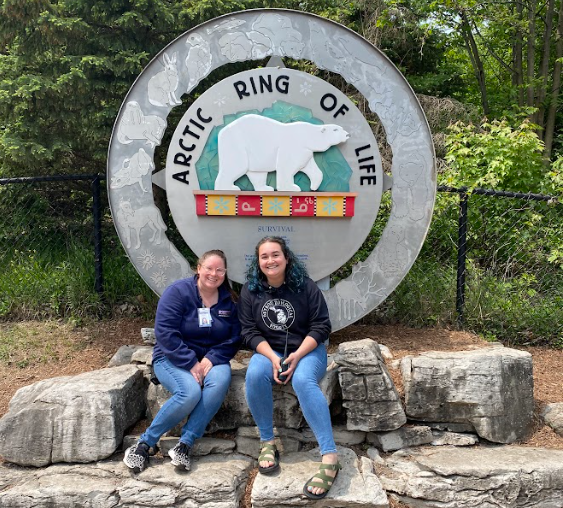
I, Cameron Kniffen (curator of education), and Bethany Wilson (education specialist) are embarking on a summit to Manitoba, Canada, in October as part of the PBI Climate Alliance Program. Our aim is to gain a deeper understanding of the impact of climate change on the Arctic ecosystems and polar bear populations on the Hudson Bay. This opportunity is possible through a strong partnership with Polar Bears International (PBI) and the National Network for Ocean and Climate Change Interpretation (NNOCCI). By observing the effects of climate change on arctic sea ice and polar bear populations at Hudson Bay, our team will bring home first-hand experiences from time spent with local knowledge holders, scientists, and experts that will contribute to further engagement in this critical field.
Cam Kniffen and Bethany Wilson.
The Arctic ecosystem is a complex and interconnected web of life, with sea ice playing a critical role as the foundation of the food chain. It is often said that sea ice is to the Arctic ecosystem as the soil is to the forest. Channels formed in the sea ice by the expulsion of salt from the freezing process create a habitat for algae, the base of the food chain in Arctic waters. Tiny organisms, like zooplankton, feed on the algae and other larger species, like Arctic cod, feed on them. Seals, in turn, feed on Arctic cod, and polar bears prey on seals. Polar bears rely on sea ice to catch their primary prey, seals, as they can out-swim polar bears underwater, but bears have the advantage on top of the ice, using it to stalk their next meal.
In addition to the crucial role that sea ice plays in the Arctic food chain, it is also vital for transportation and access to food for people living in the North. Sea ice has a global impact, acting like a global air conditioner, reflecting the sun’s light and heat back into space and helping to cool the planet. As Arctic sea ice declines in extent and thickness due to human-caused climate warming, the planet absorbs more heat, which can disrupt the climate system, leading to more frequent and extreme weather events around the world.
Today, there is thinner seasonal ice in some parts of the Arctic instead of the thicker, multi-year ice that used to be more common. This young ice is much more vulnerable to rapid melting and moves more easily, resulting in a treadmill-like effect for polar bears trying to find their next meal or mate. The last 15 years have had the lowest 15 sea ice extents in the satellite record, and the amount of old, thick sea ice is the lowest it has ever been. Studies show that Arctic open-water periods are projected to lengthen dramatically by 2,100 without action to reduce heat-trapping emissions. Longer open-water periods would greatly reduce the polar bear’s ability to hunt during these months, impact ice seal abundance and affect people and wildlife around the world.
Despite the threats, it’s not too late to save Arctic sea ice. Studies show there is no tipping point, and the ice will rebound if we work together now to shift away from fossil fuels, replacing them with renewable energy sources like solar and wind. Not only will this help reduce the carbon emissions that are causing the planet to warm and the sea ice to melt, but it will also create jobs, strengthen the economy and improve the overall environment and our health. We all have a role to play in safeguarding the future of Arctic sea ice, and there are many ways to get involved, from reducing head-trapping gasses in our atmosphere to advocating for policies that support renewable energy. By working together, we can protect the Arctic ecosystem and the countless species that depend on it, including ourselves. There are some easy ways to introduce yourself to the fight against climate change:
• Support climate-conscious policies and legislation: Speak up for Arctic sea ice. Urge officials to support renewable energy-cut emissions, and protect the ecosystem. Write, call, and attend meetings to make your voice heard.
• Raise awareness and spread the word! Spreading awareness about the significance of Arctic sea ice can contribute to preserving the Earth’s climate. Share reliable information and news with others through social media and conversations to encourage collective action.
• Adopt sustainable lifestyle choices: Switching to a plant-based diet or cutting back on meat reduces our environmental impact. The livestock industry contributes to greenhouse gas emissions, but sustainable dietary choices can help stabilize Arctic sea ice.
As part of Polar Bears International’s Arctic Ambassador Center Network, the DZS is committed to protecting polar bears and their habitat. This summit is an important step towards understanding the impact of climate change on polar bears and the Arctic ecosystem, enabling the DZS to play a vital role in mitigating the effects of climate change on polar bears and their habitat.
Our expedition to Manitoba, Canada and involvement in the PBI Climate Alliance Program are critical steps toward understanding the impact of climate change on polar bears and the Arctic ecosystem. The partnership between the DZS, PBI and NNOCCI demonstrates the power of collaboration and knowledge-sharing in promoting conservation and sustainable practices. By working together, researchers, educators and community members can pool their resources and expertise to develop innovative solutions that will enable us all to safeguard the future of our planet.
Together, we can ensure the continued health and well-being of oceanic ecosystems and the species that rely on them, including polar bears.
This week, hundreds of millions of birds will leave their winter habitats from as far away as the Amazon rainforest and Andes mountain range on their annual journey to reach their summer breeding grounds across North America and right here in Detroit! Migratory bird species travel along ancestral routes defined by waterways and often travel under the starlight at night. Fluttering along geographic landmarks like the Mississippi River and the shores of the Great Lakes, birds as small as the ruby throated hummingbird head to their summer homes thousands of miles further north.
Saturday, May 13 is World Migratory Bird Day, which amplifies the critical importance for birds to have access to water throughout their journey. Waterways serve as sources for food and habitat during migration and year round. At the Belle Isle Nature Center, birds are celebrated on this day — and every day — through education and conservation practices that promote their right to access food, water and habitat.
As the month of April came to a close, a time when the frequency of bird migration really picks up in the Detroit area, the Belle Isle Nature Center hosted Michigan Public Radio’s live broadcast event “Bird Nerds Unite.” This event featured a panel of local experts who discussed all things birds: the birds who are migrating through now, those who reside in southeast Michigan all year and tips for noticing birds right near your home.
You can watch or listen to a recording of the presentation here.
Even the youngest among us can appreciate the birds in their neighborhood. Don’t just take our word for it — here’s what Marlin Franklin, Brightmoor community engagement manager with Brilliant Detroit, had this to say about the Belle Isle Nature Center’s after school program, Neighborhood Nature Explorers.
“Contrary to popular belief, bird watching is not boring! It is amazing fun for kids and adults,” he says. “We celebrated bird day at the Brilliant Detroit Brightmoor site with Micah Blake-Smith from the Belle Isle Nature Center. We learned the proper way to use binoculars. We identified birds that live and forage for food in our neighborhood, and we made feeders for those birds that we hung in the trees. Our little people will grow up to be good stewards of the earth with classes like these.”
If you think that’s something, come experience the excitement that awaits from bird watching during sunset or with the use of audio ID technology at the Belle Isle Nature Center’s free programs.
Nature at Night
A flutter of green, a jolt of red, a fleck of gold – a pheasant ducks through the underbrush in a burst of color. Whether it is the visual rainbow of feathers or a symphony of a bird chorus saluting the setting sun, hikers and bird watchers can find themselves knee deep in renewed prairie while birding on Belle Isle. Our Nature at Night program gives participants an opportunity to discover spaces that burst with life as the sun goes down. Join us for our next free hike from 5 to 9 p.m. Thursday, May 18. Guests are welcome to bring binoculars or borrow a pair from the Nature Center.
Science Hikes
More of a morning bird than a night owl? There is also a daytime Science Hike planned for 2 to 3 p.m. Sunday, May 21. This “technologically enhanced” bird walk utilizes the Merlin Bird ID app. Participants will be provided with iPads and can use the app to help them identify birds from their song. A recent walk on the Nashua Canal Trail, a 1-mile accessible pathway through the heart of Belle Isle, revealed ruby-crowned kinglets, red headed woodpeckers, white-throated sparrows and one very impressive eagle’s nest.
As spring bird migration winds down in June, the community group Black to the Land Coalition will host their annual birding event at the Belle Isle Nature Center called Blacks, Browns and Birds from 10 a.m. to 2 p.m. Saturday, June 3. This allows for Black and Brown families to come together in green spaces, connect with the land through bird watching and enjoy other outdoor activities.
For more information about upcoming, free programs and events, visit our website. The Belle Isle Nature Center is open seven days a week, and we are happy to give tips on where to head for your own bird walk. Celebrate World Migratory Bird Day on Saturday, May 13 or any day of the year by noticing where you find nature in your neighborhood.
This entry was written by a gaggle of geese: Ryan, Luke, Courty, Micah and featuring Marlin Franklin of Brilliant Detroit
You don’t need to head up north or plan a camping trip to connect with nature – there are amazing animals all around us! Let us introduce you to three of your wild neighbors.
They call it mudpuppy love!
Mudpuppies are the second-largest salamander in the western hemisphere. These amphibians may not give off total puppy-dog vibes, but when you see them up-close and in-person, you can’t help but to fall for their charms. There is even a whole celebration in their honor called Mudpuppypalooza taking place March 26 at the Belle Isle Nature Center!
Mudpuppies have wide faces and frilly, external gills on the sides of their heads that act like filters in the water. This means they need to live in clean water to stay healthy. These pups spend most of their time under the cover of flat rocks or slabs of concrete at the bottom of rivers – including our very own Detroit River. They are an important part of Michigan’s aquatic ecosystem, and the Detroit Zoological Society has been collecting data on mudpuppies and water quality in the Detroit River since 2004. Learn more about our monitoring efforts.
Say hi to Michigan’s largest snake!
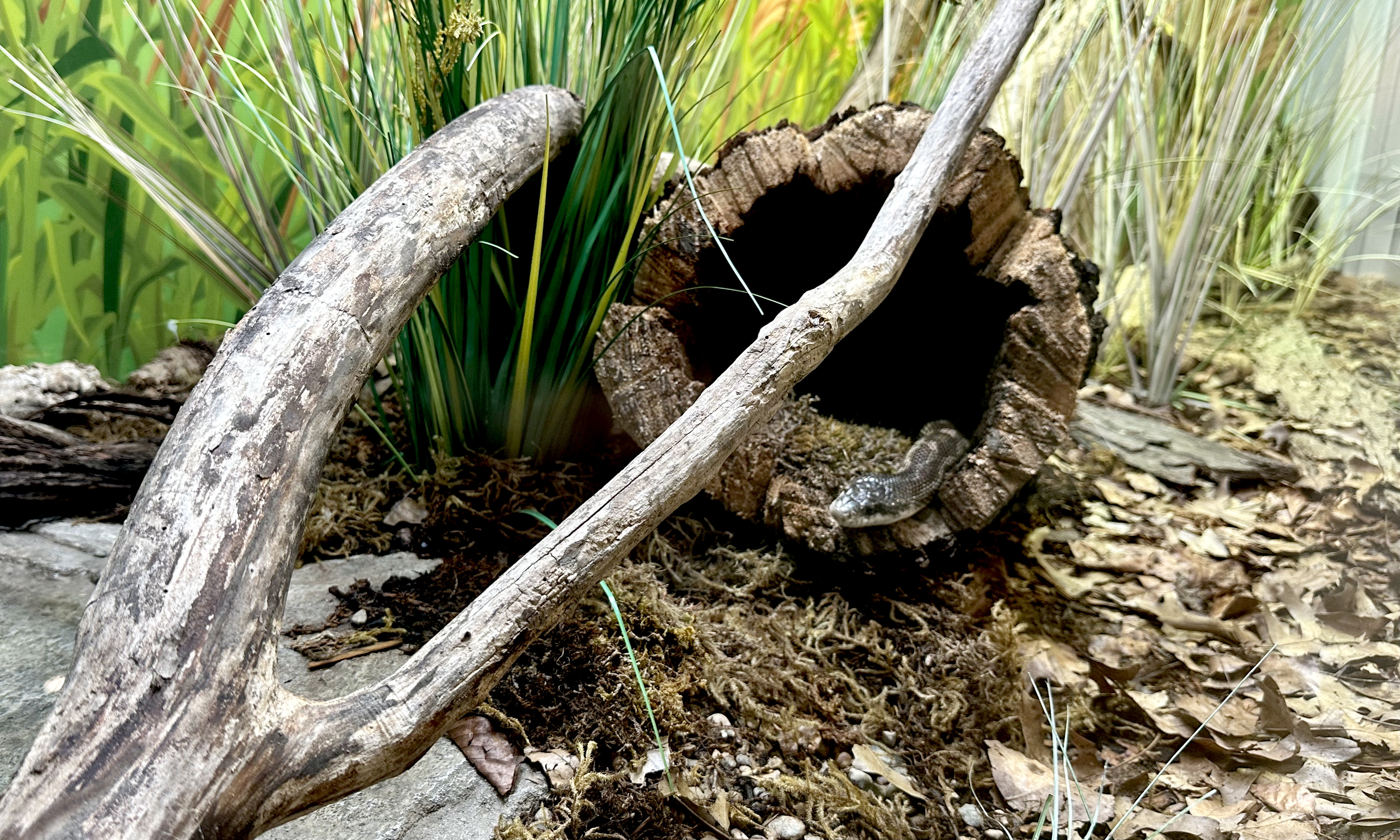
Black rat snakes can grow to be an impressive 8 feet long – but don’t worry, they are non-venomous and harmless to humans. Rodents, however, are not so lucky. As their name suggests, this species hunts rats and will often enter barns or abandoned buildings in search of food. They use the constriction method of hunting and consume their prey in a single bite! Rat snakes can also be found hiding in tall grasses, under fallen trees or in hallowed out logs, just like our friend here, who just emerging after a taking a nice afternoon nap. The habitats at the Belle Isle Nature Center are designed to mirror the landscape the species might experience in the wild – do any of the elements look familiar to you?
Do I spot a spotted turtle?
If you have visited our Nature Center before, you may be familiar with our turtle pond. This expansive indoor habitat is home to several turtle species, including this pair of spotted turtles. They may be smaller than most of their pond mates, but as you can see from this video, they make up for it in moxie! Spotted turtles can be found in bogs, marshes, swamps, ponds and woodland streams throughout Michigan. They can often be seen basking in the midday sun, but when surprised, spotted turtles will dive underwater and completely bury themselves in the mud. They also retreat to these muddy beds to stay cool on hot summer days. Spotted turtles in Michigan are threatened by habitat loss and from being removed from the wild by reptile collectors. That brings us to a rule that applies to all wild animals – look don’t touch! This is the best way to keep your new friend safe.
The Belle Isle Nature Center is all about making connections. People, animals, natural and unnatural landscapes are all a part of the unique tapestry that is Detroit. Visit belleislenaturecenter.detroitzoo.org to plan your visit. The Nature Center is open every day from 10 a.m. to 5 p.m. and and is always free!























 Detroit Zoological Society Blog