Notes from the Field: Antarctica’s Influence on Penguin Habitat Design

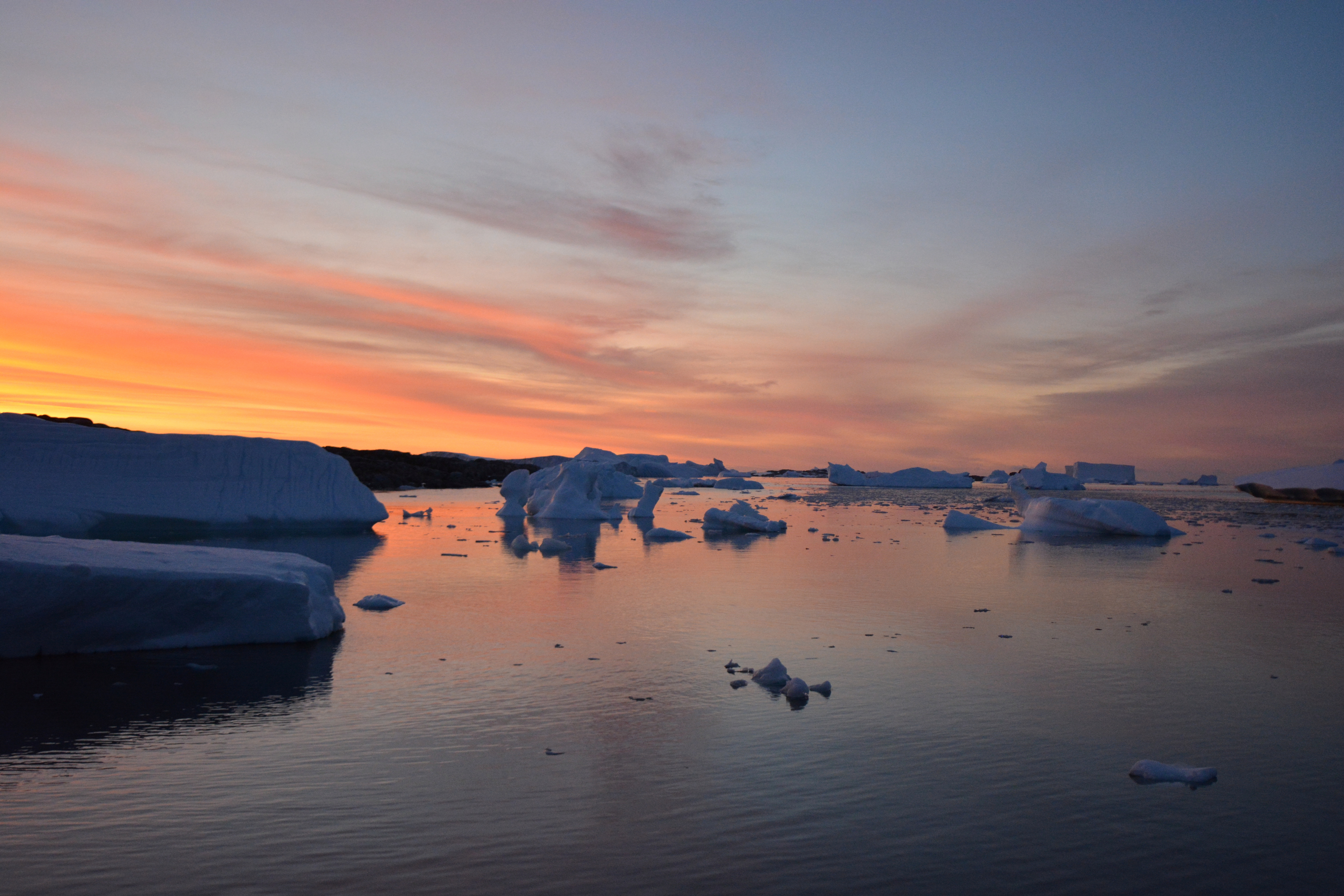
As I walk to and from my office every day at the Detroit Zoo, I watch the Polk Penguin Conservation Center taking shape and I revel in its beauty. Now, after returning from an expedition to Antarctica, I marvel in how the design of the building truly resembles the tabular icebergs found there.
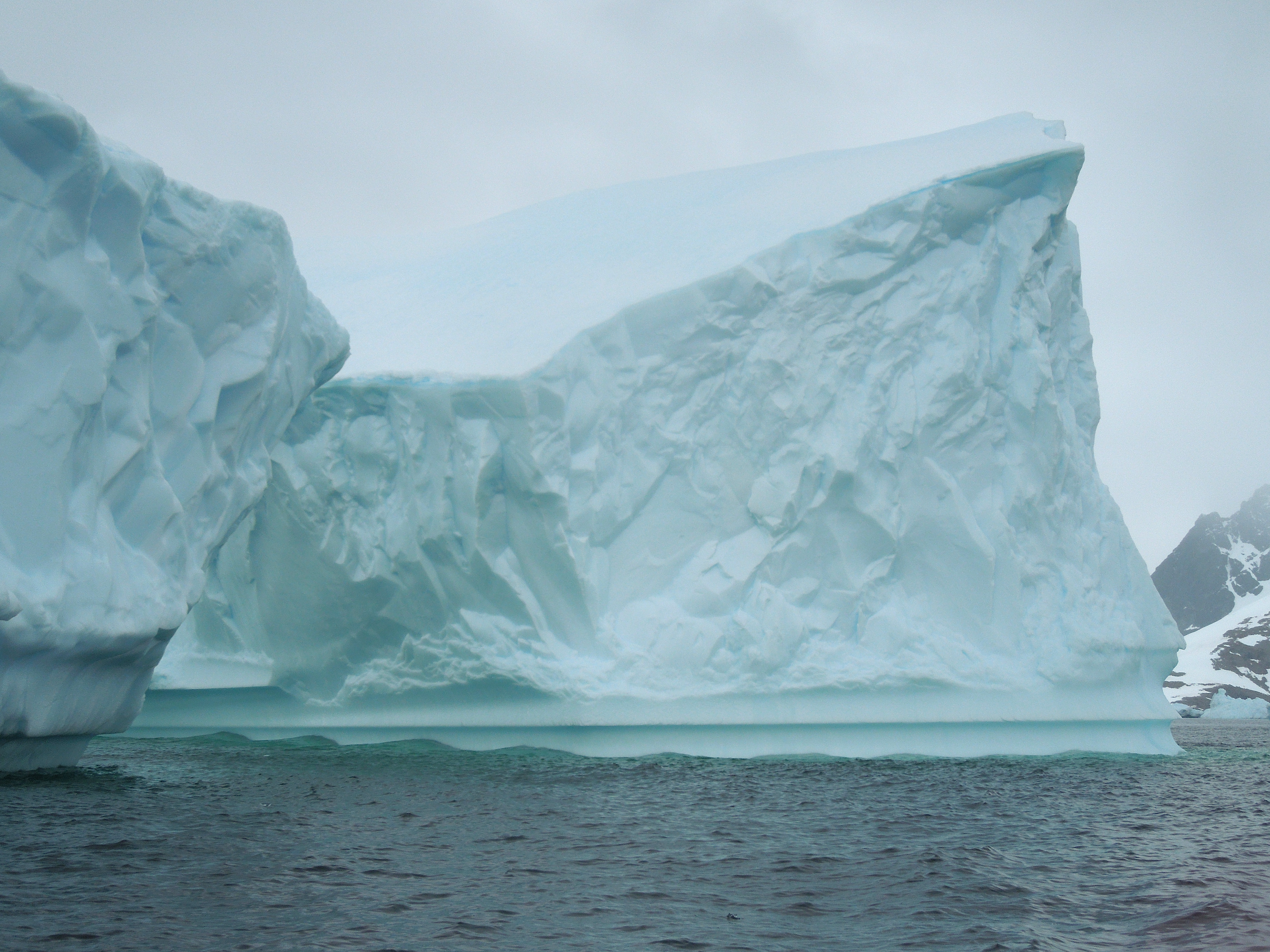
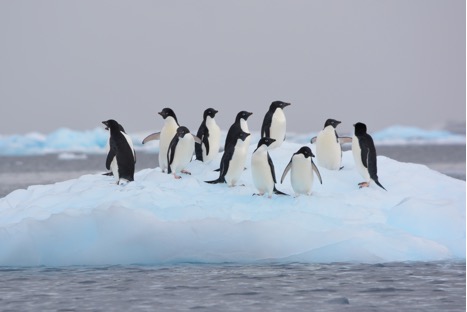
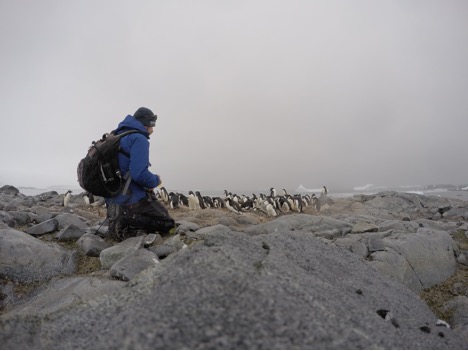
As the Detroit Zoological Society’s associate curator of birds with 22 years of experience working with penguins, I felt right at home in Antarctica – between the overwhelming smell of penguin guano, the sound of penguin chicks vocalizing and the pitter-patter of penguin feet as they walked to and from their nests. It was awe inspiring to witness their natural behaviors, from lying on the ice if they were too hot to collecting rocks for nesting to porpoising in and out of the water while foraging for food.
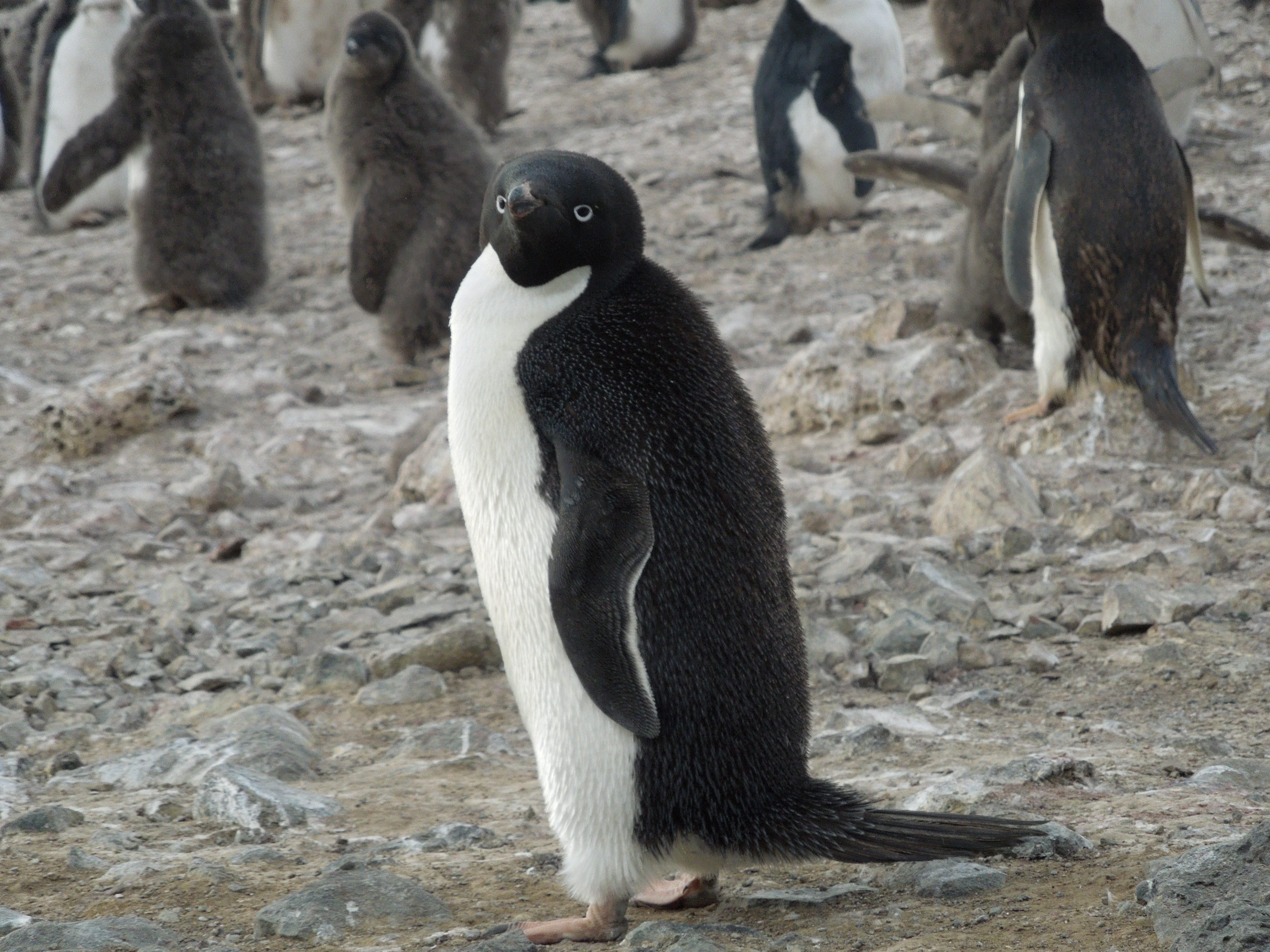
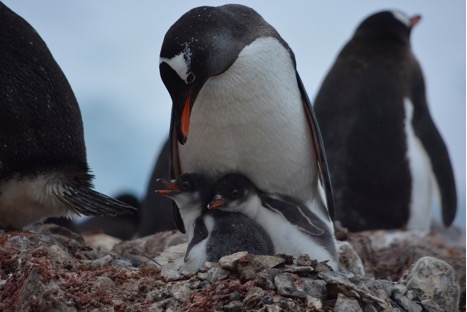
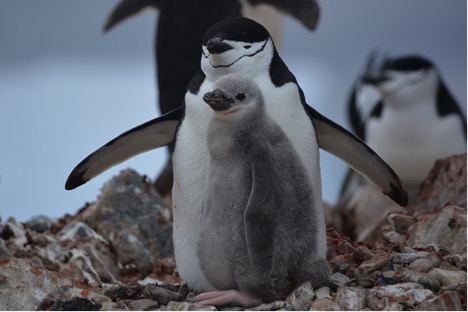
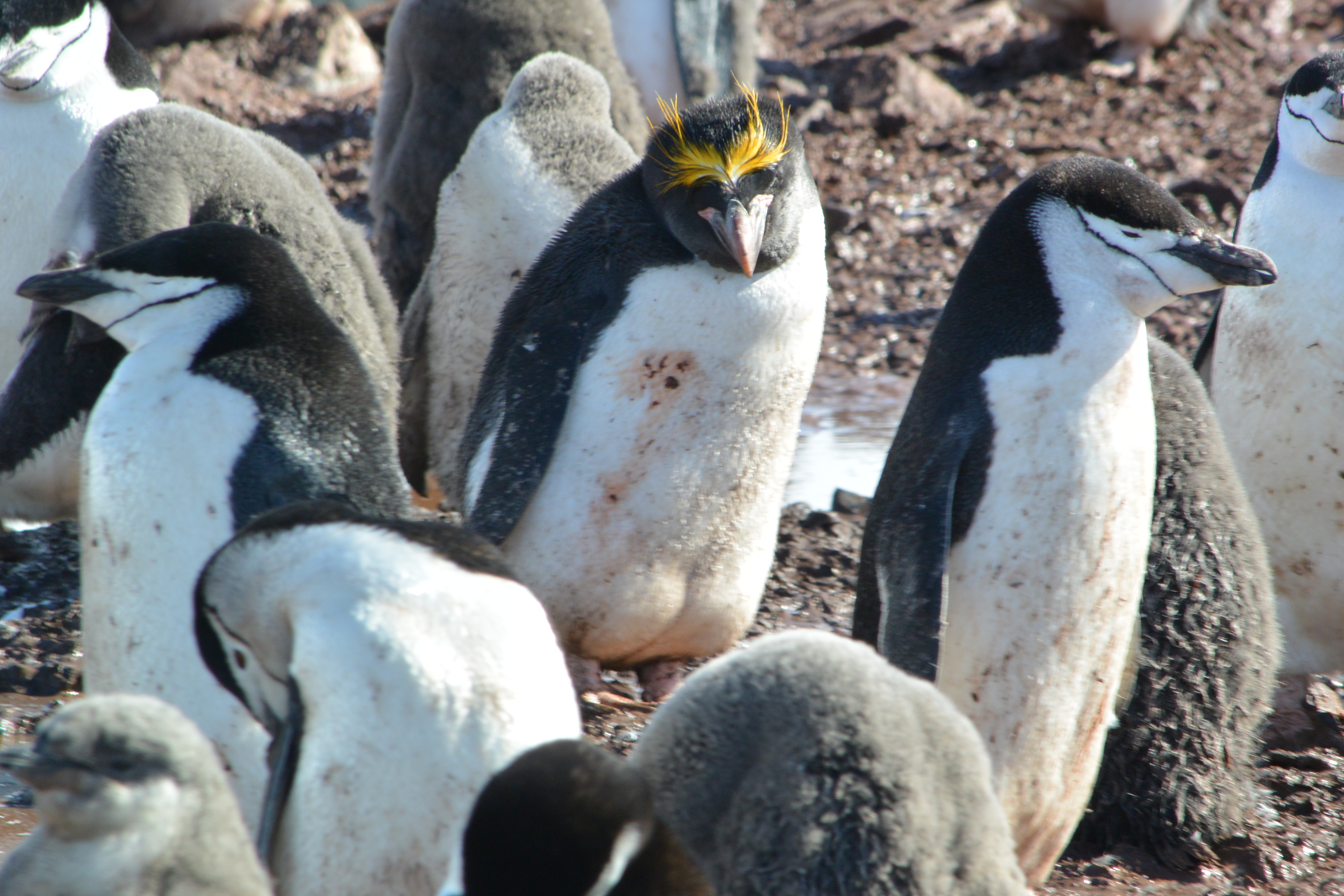
While designing a new habitat for the penguins at the Detroit Zoo, we consider all of these things and provide opportunities for the aquatic birds to exhibit these behaviors. It was fascinating to observe penguins tobogganing – lying on their bellies and moving through the snow with their flippers – a form of transportation for penguins in a hurry. We were also fortunate to see many chicks near fledging – parents were returning from the sea with full bellies of food for their chicks, and some chicks were taking their first swim in the water. I knew we would encounter three species of penguins – Adelies, gentoos and chinstraps – but I was astounded to see the one lone macaroni penguin that lives amongst a colony of chinstrap penguins.
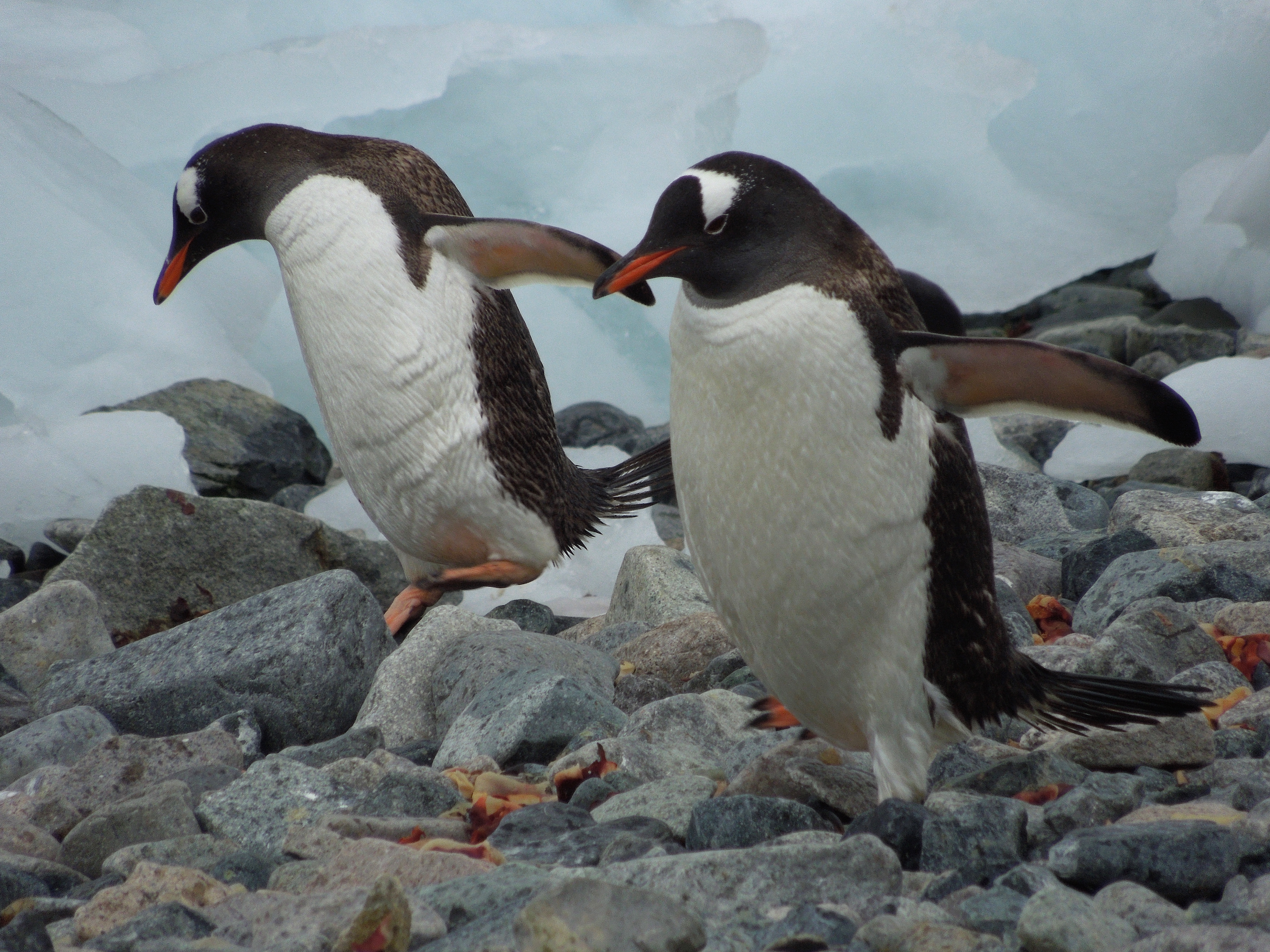
Observing thousands of gentoos was a highlight of the trip, as it is a fairly new species to the Detroit Zoo, and the 20 gentoo penguins currently in quarantine at the Zoo will be a wonderful addition to the penguin population here.
These observations of how penguins spend their time in the wild will directly influence the home we provide for penguins at the Detroit Zoo. We can include more rocks in the penguins’ habitat, offer a variety of nesting materials other than rocks, provide hills of snow for climbing – not just for standing on – and we can let the penguins choose their nesting site, even if we think there is a better location.

Wonderful conversations transpired among animal care staff, veterinarians and researchers – including world-renowned polar ecologist and penguin expert Dr. Bill Fraser and his wife Donna Patterson-Fraser – all of us sharing our observations and questions with each other about what we were seeing in the field. One of our final destinations was to the U.S. Palmer Station to pick up Matthew Porter, a bird department zookeeper for the Detroit Zoological Society. He has been assisting the “Seabird” field team, a division of the Long Term Ecological Research Network, focusing on penguin research for the last few months. Matthew – and those of us on this expedition – will be sharing the wealth of knowledge we have gained from this experience with staff and guests at the Detroit Zoo.
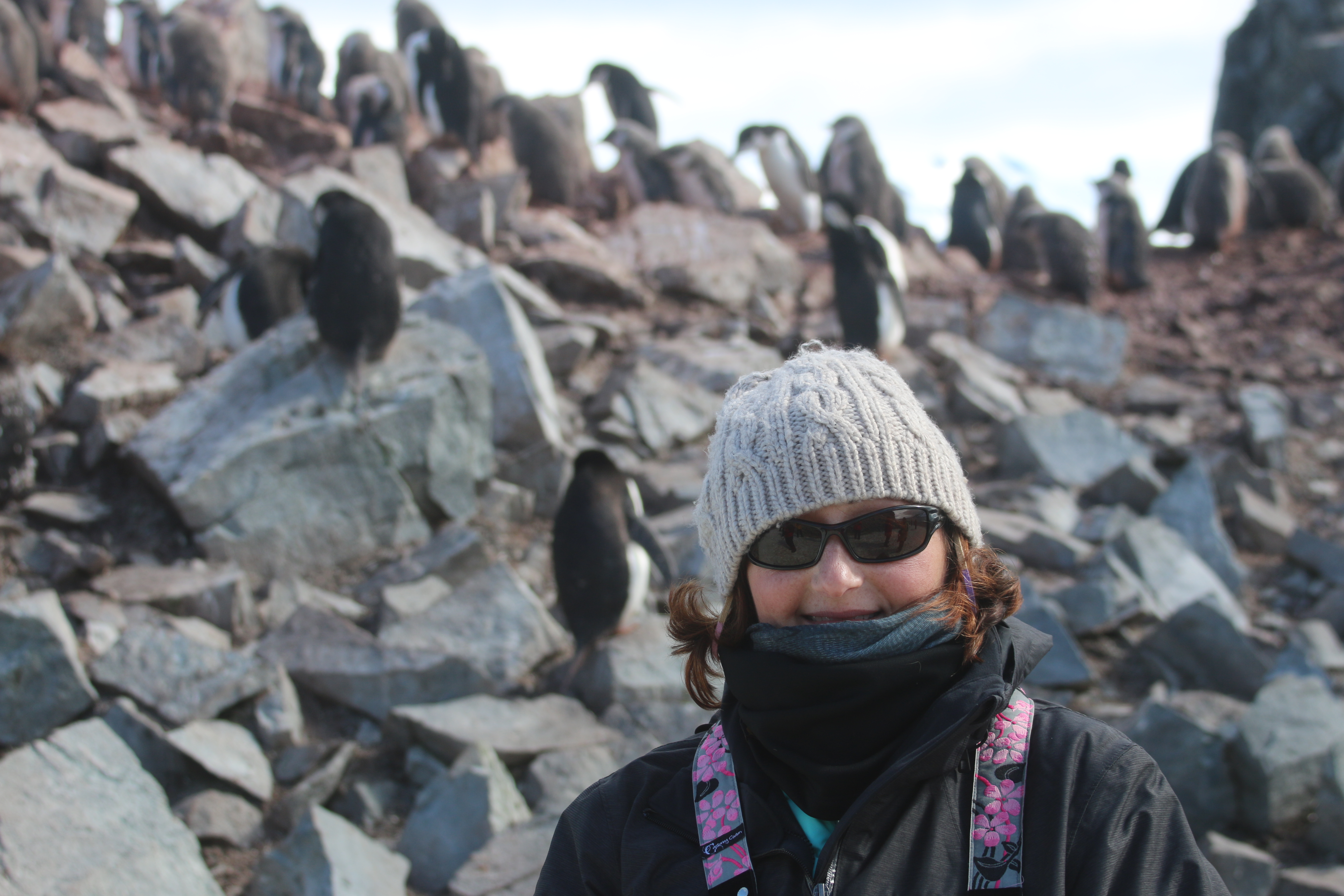
– Bonnie Van Dam is the associate curator of birds for the Detroit Zoological Society.
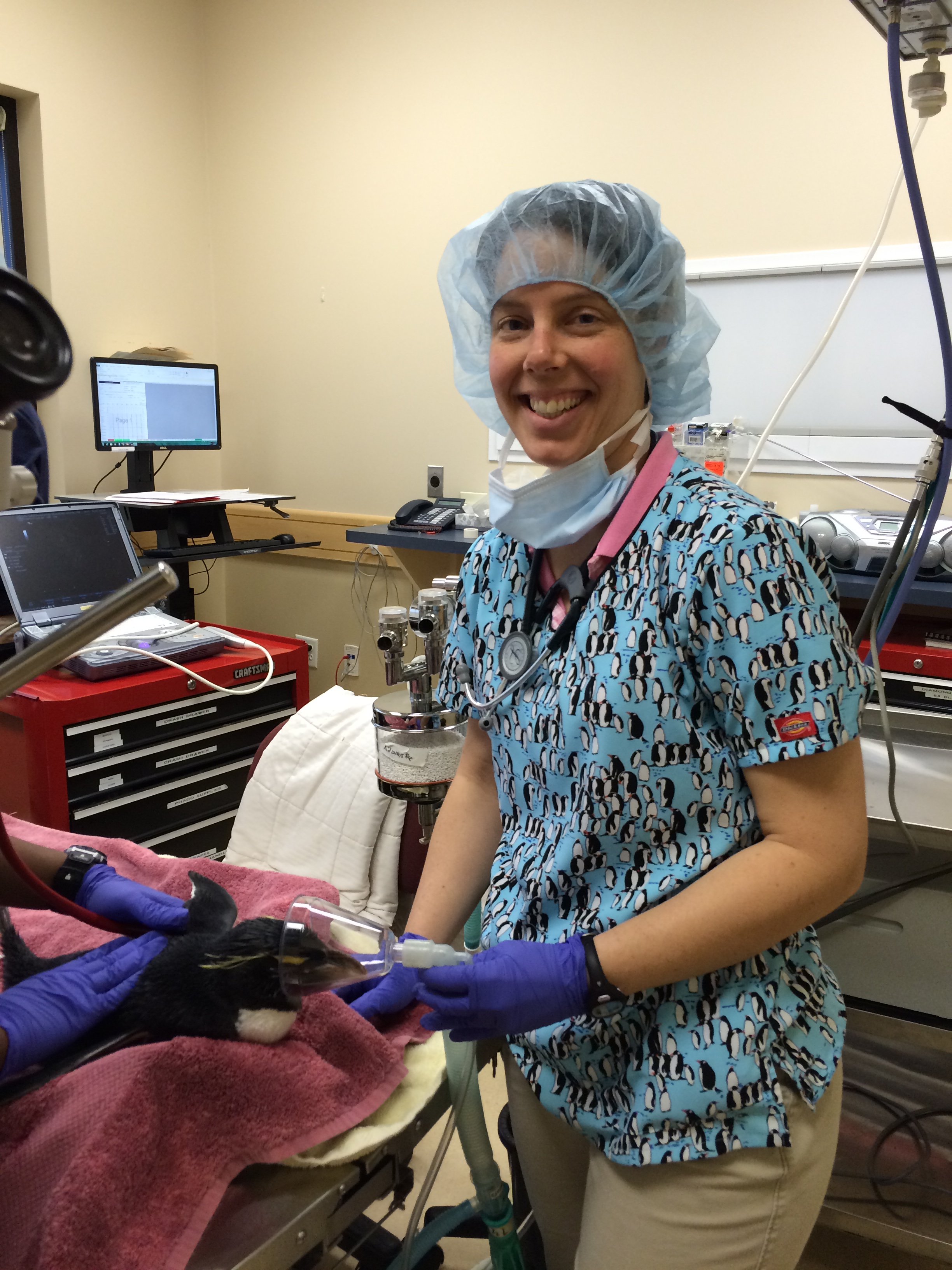
Veterinary Care – Antarctica Brings a New Respect for Penguins

I have a new respect for penguins. As one of the veterinarians at the Detroit Zoo, I know a lot about these aquatic birds – how to collect blood from a penguin, how to anesthetize a penguin, what types of medications I can give to a penguin, and how the inside of a penguin should look on a radiograph (X-ray image). In fact, the day before I left for an expedition to Antarctica, my veterinary ophthalmology colleagues and I restored vision to two of our rockhopper penguins by performing surgery to remove their cataracts. However, after visiting these amazing little birds on their home turf and seeing how they live their daily lives, I realize that I had no idea how a penguin actually “works”.

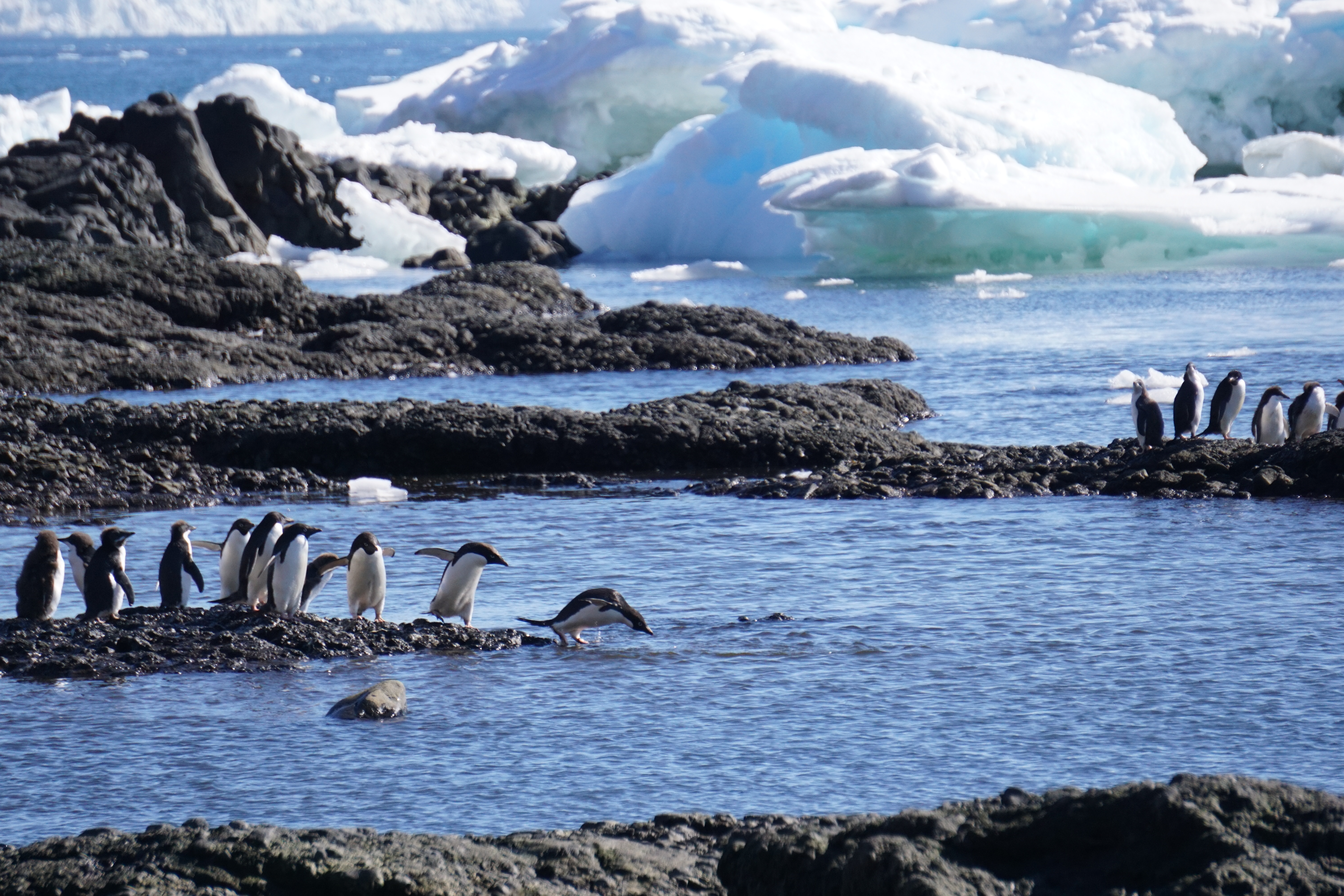
Antarctic penguins live incredibly harsh lives, but they make it look simple. They appear to be perfectly at home in 29°F salt water. That is not a misprint. The salt causes the water to freeze at a lower temperature than fresh water, so they actually swim daily in water than would be frozen if it were in the Great Lakes. We saw penguins everywhere in the water, swimming like bullets and porpoising with ease at high speeds. Penguins, in fact, live most of their lives at sea. Their only use for land is during a relatively brief nesting, breeding and molting season. Our visit to Antarctica took place during the austral summer and, at this time, the penguins are on land for breeding. Although their stout little bodies and short legs are much more suited to swimming, they manage to navigate rocks of all shapes and sizes, sometimes climbing steep and treacherous cliffs to get to their chicks. Aside from a few relatively flat beaches, we rarely saw penguins walking on level surfaces. They do fall occasionally, sometime frequently, but they get up every time and continue on their mission.

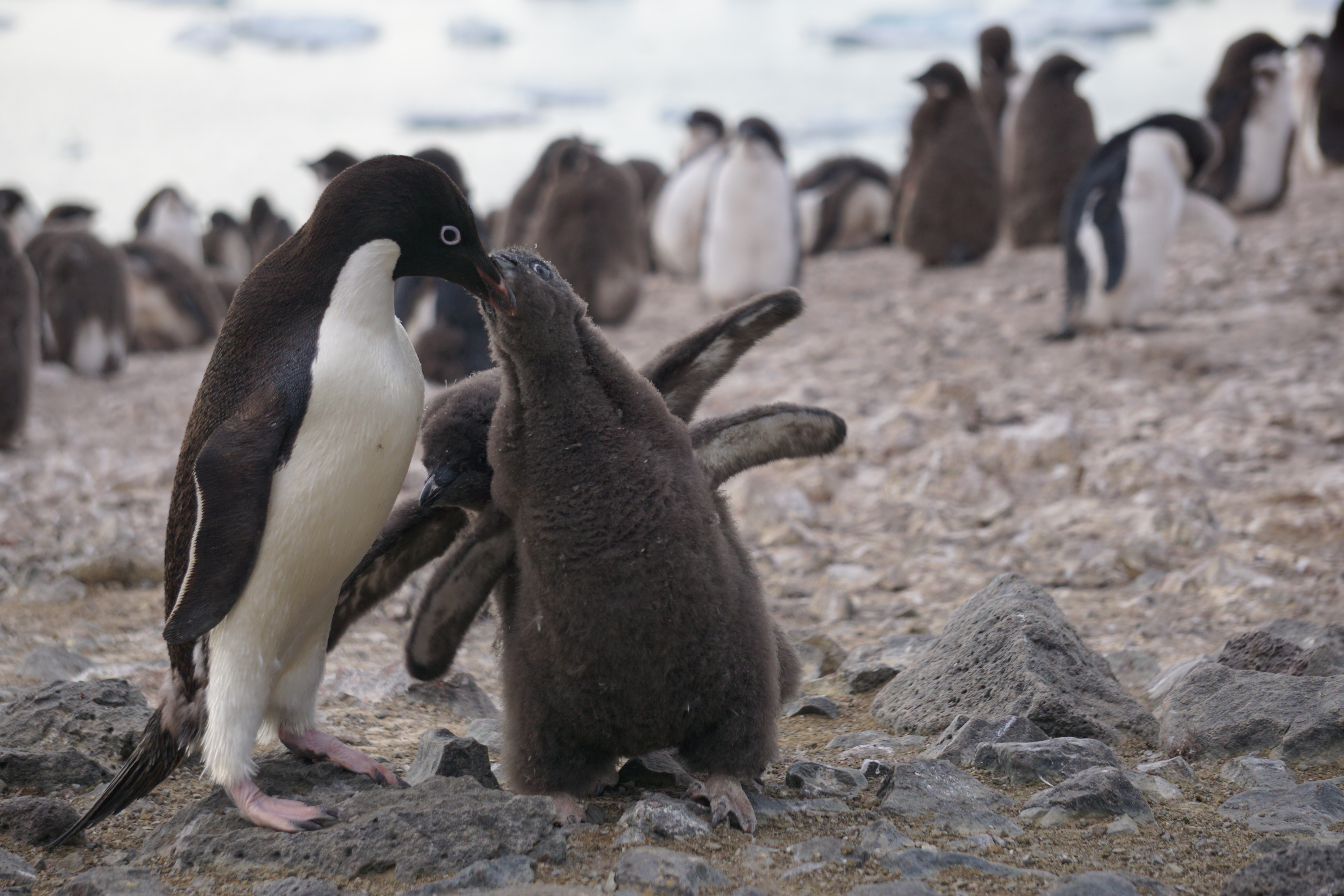
Late in the breeding season – when we arrived – penguin parents spend hours hunting for food in the water and then return to feed their chicks, who are at this point nearly the same size as their parents.  After the parents have hunted all day – making difficult and treacherous climbs up the rocks – their large, pudgy chicks seem much more greedy than grateful for all of the parents’ hard work and dedication.  After feeding all that they have to their chicks, the adults head directly back down the treacherous rocky cliffs and back into sub-freezing cold water to start over again.

These amazing birds live such a hard life, and they make it make it look easy. Or maybe not easy, but they manage it. Because it’s what they do. It’s how they “work”. Now that I’m back at the Zoo working with our penguins, I have so much more awe and respect for these amazing creatures, and I feel so fortunate to have had the opportunity to witness the workings of wild penguins firsthand.

– Dr. Sarah Woodhouse is a veterinarian for the Detroit Zoological Society.
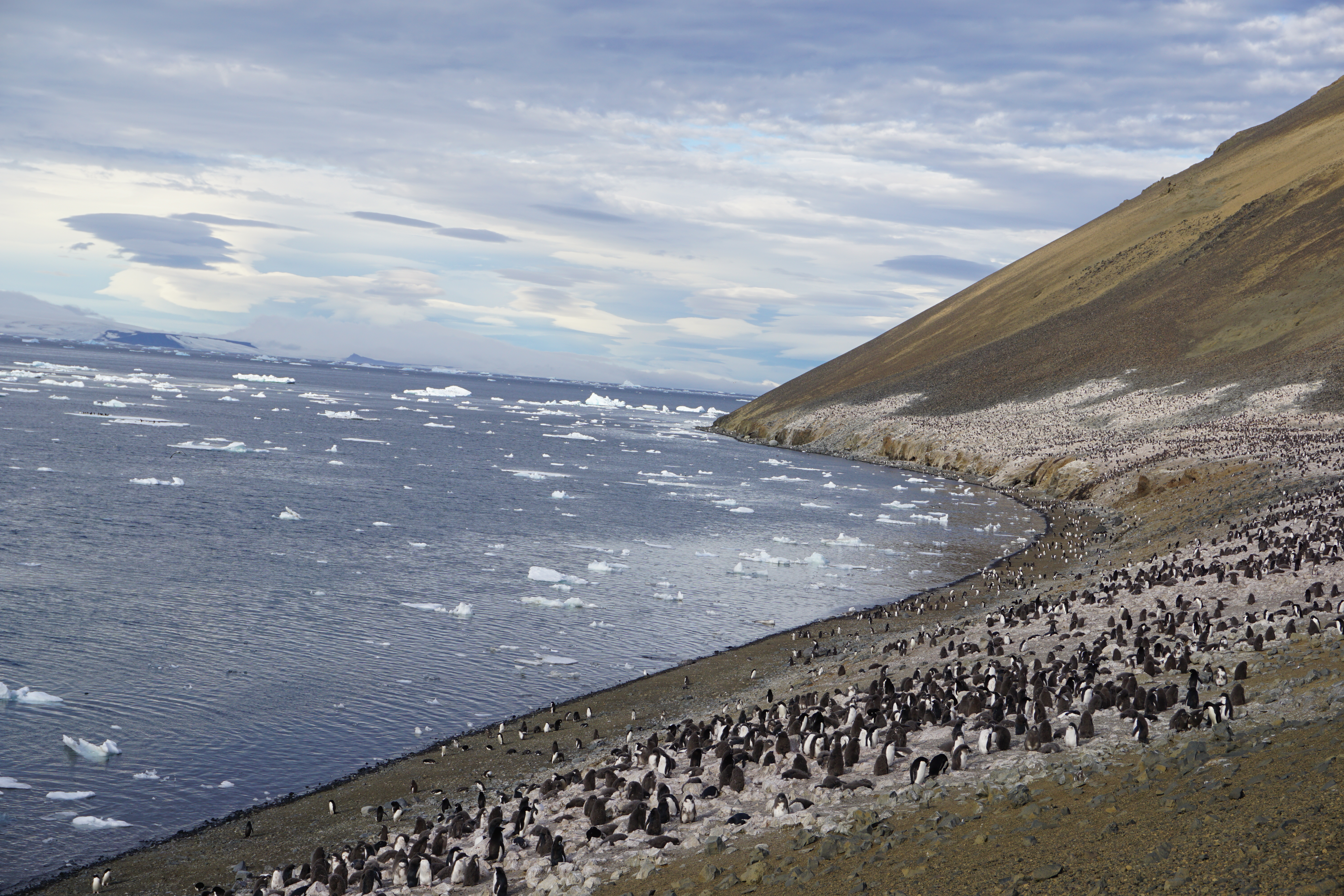
Notes from the Field: Saying Goodbye to Antarctica

In what seems like the blink of an eye, this incredible journey at the bottom of the Earth has come to an end as I write to you back home at the Detroit Zoo. Three months ago, I flew to Chile, sailed across the Drake Passage and landed on Anvers Island in Antarctica. My home became the U. S. Palmer Station where I joined the expert field team of Polar Oceans Research Group.

We zodiac’ed around the local waters through wind, snow, and ice day after day, traversing the stunning landscape to study penguins, skuas, southern giant petrels, and more. Through the quick Antarctic summer, we travelled to many rocky islands, watching the birds lay eggs and diligently incubate them to hatching. Then the dedicated parents brooded their chicks, foraging often to find krill, fish, and more to feed their downy kin in an effort to raise them to maturity.

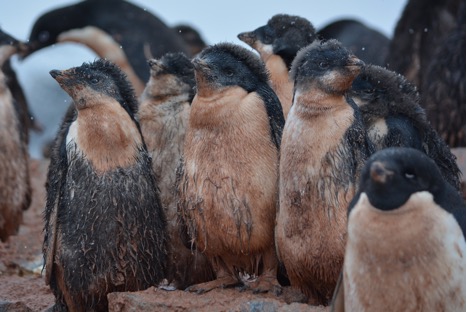
In my final days of observation, the birds continued to grow. The Adelie chicks lost most if not all of their down and are were almost ready to hop in the Southern Ocean for their first swim. The chinstraps were just behind them, but the gentoos were still downy, with a little more time to grow before hitting the chilly waters. The brown skua chicks were running all over the place as their primary flight feathers were quickly developing. The southern giant petrel parents were regularly leaving their chicks alone at the nest while they went out in search of food.

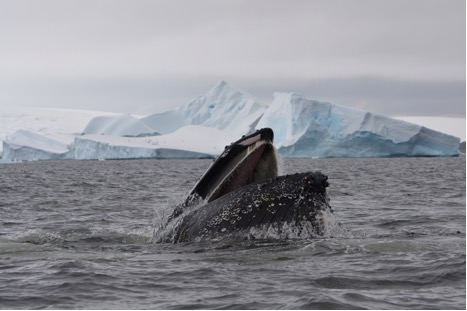
As we studied the birds, we had to watch out for the many fur seals that had joined the neighborhood, as they do around this time every year. We also saw a couple more humpback whales in the area. One playful individual made quite a commotion on the surface and was repeatedly lunge-feeding, devouring lots of krill.

Antarctica is now a part of me, and a very special part of our world. The Antarctic peninsula is one of the fastest changing places as the world’s environment changes. It will take a worldwide effort to help our planet, but every conscious decision you make to respect, recycle, and conserve will help turn the tides. I am so proud to be a part of our Detroit Zoological Society. Please walk with us down the path of sustainability. Thank you for reading and joining me on this extraordinary journey.

– Matthew Porter is a bird department zookeeper for the Detroit Zoological Society who spent the last few months at the U.S. Palmer Station in Antarctica for a rare and extraordinary scientific opportunity to assist a field team with penguin research.

Education: My Heart is Like a Zoo

February is the perfect month to share one of our favorite children’s books: “My Heart is Like a Zoo”, by Michael Hall. This book is cleverly illustrated with colorful animals that are composed of heart shapes, and we’ve used it to facilitate a variety of activities through the Detroit Zoological Society’s education department. Most recently, our team prototyped an activity based on the book’s illustrations to use in our monthly programming at local pediatric hospitals. Staff or volunteers will read the book and talk about the animals, shapes and colors, depending on the age of the audience.

After reading the book, the children are provided heart shapes made from construction paper. They are various sizes, colors and configurations. The children can use the hearts we provide or create their own as they construct animals out of the shapes. The activity builds spatial relations, pattern building, color blending and fine motor skills.

The young men at Children’s Village, a juvenile detention facility we work with year-round, use the book as inspiration as they create Valentine’s Day cards for children at local pediatric hospitals. We bring a variety of paper with us and the boys create animals out of the heart shapes for the front of the card. On the inside they write thoughtful messages for the recipients. Providing opportunities for these young men to think about other people in a compassionate way and make a positive impact through something they’ve created leaves a lasting impression on them.

“My Heart is Like a Zoo” is available at most area libraries to borrow or at local bookstores if you’d like to bring it home forever. We hope you enjoy it as much as we do!

– Claire Lannoye-Hall is a curator of education for the Detroit Zoological Society.
Notes from the Field: Growing up in Antarctica

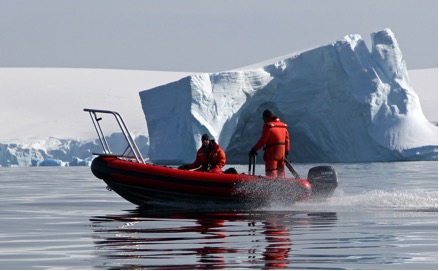
Greetings from Anvers Island! The front of the U.S. Palmer Station doesn’t usually have many icebergs, but this summer, the waters around the station have become something of an iceberg parking lot. The last few days have been breezy with a couple inches of summer snow, but that has not stopped us from making our rounds. Throughout the area, the seabirds are busy raising demanding chicks while humpback whales are swimming by.

The south polar skuas are just starting to hatch and we are seeing their chicks on a couple of the islands. The brown skua chicks have grown significantly. Their primary flight feathers are starting to come in and they are becoming more challenging to measure. The sneaky youngsters are often hiding behind rocks away from the nest. They are quick on their feet and run from us when we approach. The ages of the southern giant petrel chicks vary with some newly hatched and others barely fitting under their brooding parent because they’ve grown so much. Often as we walk by, we’ll see a fuzzy white head sticking out under mom or dad.

All of the penguin chicks are growing rapidly but the gentoo chicks are the smallest, with many still fairly young. These chicks are very cute; their beaks already show orange and somehow the young birds manage to stay very clean.


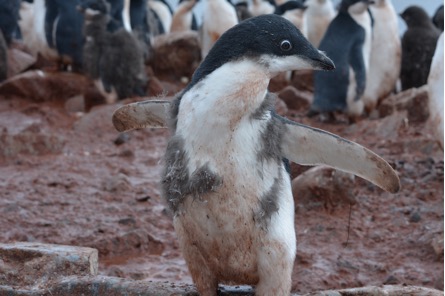
The chinstrap chicks are also tidy-looking and have grown significantly. The Adelie colonies are thinning out as the parents are spending more time out foraging. Their extremely messy chicks are forming groups called crèches. At this stage, the young birds are really starting to grow up and are willing to venture away from their nest to hang out with other chicks. The oldest chicks are in the process of molting their down and many look quite funny. They are partially covered in down with some of their first molt showing. This next generation of penguins is developing quickly, which is important as the quick Antarctic summer is flying by.

As I reflect on this wonderful journey, I continue to marvel at the purity of Antarctica’s environment. Please try your best to respect the environment wherever you are and leave behind the smallest footprint you can. We share an incredibly beautiful world and it’s all of our responsibility to protect it.

Thank you for reading.

– Matthew Porter is a bird department zookeeper for the Detroit Zoological Society and has spent the last few months at the U.S. Palmer Station in Antarctica for a rare and extraordinary scientific opportunity to assist a field team with penguin research.

Veterinary Care: Dental Health in Exotic Animals

Dentistry is a very important component of veterinary care for the animals at the Detroit Zoo. Many of the animals here live longer than their wild counterparts, so ensuring that they have healthy teeth throughout their lifetime is a priority.

Dental issues can have a big impact on comfort and the overall well-being of an animal. We sometimes find that if an animal is showing a decrease in appetite or is experiencing weight loss or other problems, they ultimately have underlying dental problems. Whenever we do an exam on an animal, we are sure to carefully examine the teeth for problems and to scale and polish them to remove tartar or plaque. If we see problems or areas of concern, we take skull or dental radiographs to look for problems under the gum line, just like you experience during your routine dental visits.

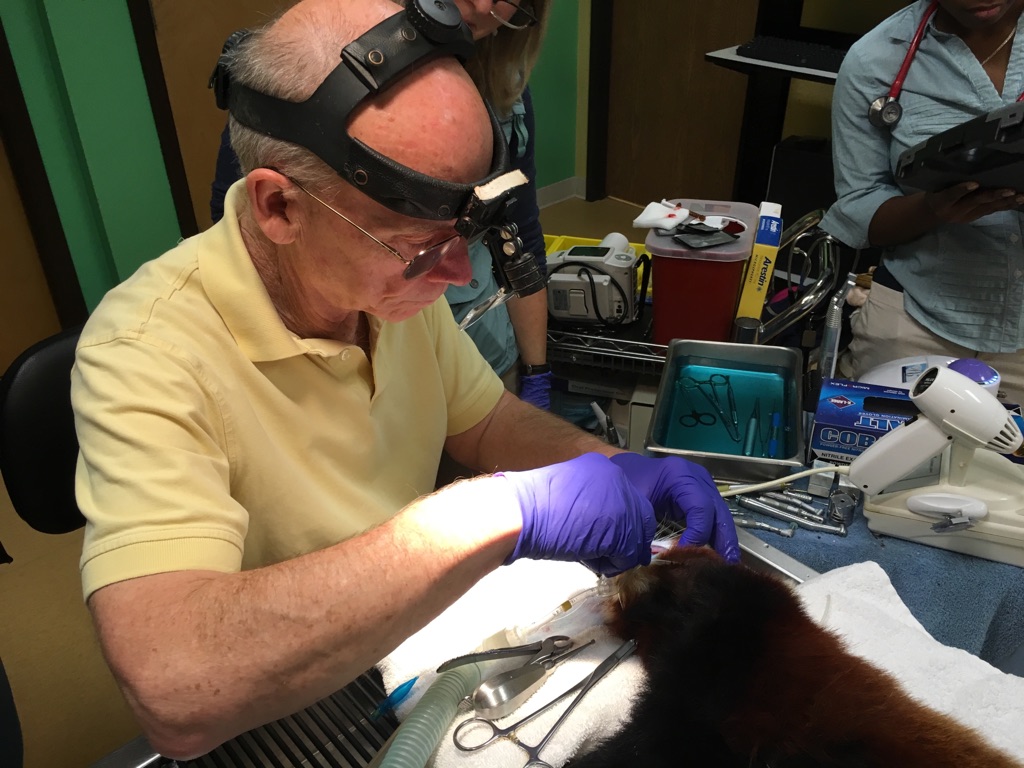
Recently, one of our zookeepers noticed that a red panda was not opening his mouth fully when taking in food items such as grapes. We examined him under anesthesia three times over a short period, and despite anticipating a dental issue, we were unable to find any areas of concern during examination and radiographs. We collected diagnostic samples and treated him with antibiotics and anti-inflammatory and pain medications. Each time, the problem improved and then recurred. When the red panda started having problems most recently, we decided to transport him to a nearby veterinary specialty practice for a CT scan. This advanced imaging technique took only about 20 minutes, and was able to clearly delineate an area of infection underneath one of his upper molars. Usually dental issues can be pinpointed with regular radiographs, but in this case diagnosis proved extra challenging.

We made arrangements to transport the red panda to a board certified veterinary dentist, Dr. Ben Colmery at Dixboro Veterinary Dental and Medical Center in Ann Arbor. Dr. Colmery was able to remove the problem tooth, which allowed the infection to drain clear of the area. Within days, the red panda was opening his mouth wide to eat all of his food items and seemed much more comfortable.

Every member of the Zoo’s veterinary staff helped during one or more of the red panda’s examinations and treatment. This case demonstrates how teamwork, persistence, and assistance from outside experts can lead to a great outcome for our treasured animal patients. I’m thankful for the assistance that we receive from our veterinary colleagues, and proud of the great work that we do in the Ruth Roby Glancy Animal Health Complex!

– Dr. Ann Duncan is the chief veterinarian for the Detroit Zoological Society and oversees the Ruth Roby Glancy Animal Health Complex at the Detroit Zoo.

Greenprint: Five Home Improvement Projects to Prioritize

If you’re like me, you’ve already started a short list of home improvement projects to invest in with your 2015 tax return. Below is a list of five home improvement projects that you should prioritize because tax incentives are currently set to expire at the end of 2016. These projects will bring you short and long-term savings by increasing your energy efficiency as well as savings in the form of tax credits.

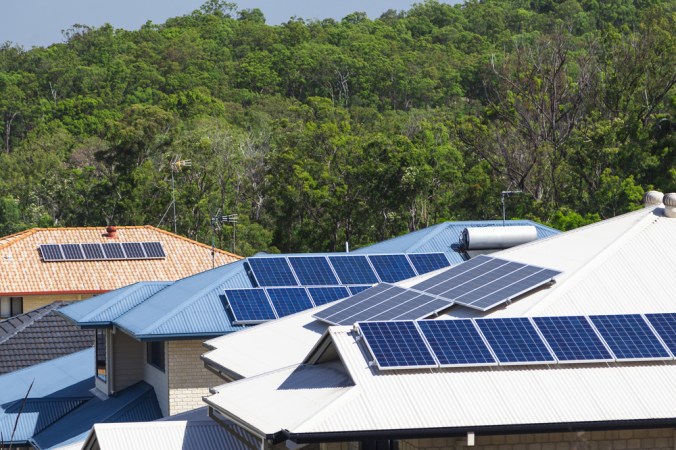
  • A new ‘Cool Roof’: By selecting a light colored roof material (metal or asphalt), you’re decreasing the amount of heat that’s absorbed by your home. You can also claim a tax credit that’s10% of the material cost up to $500.

solar cool roof

  • Replacing doors, windows or skylights: ENERGY STAR qualified materials will bring you savings in heating, cooling and lighting as well as a 10% tax credit up to $500 ($300 for windows).

skylight

  • Going Tankless: Heating water can account for 14-25% of your homes energy use. Investing in an energy efficient model will give you energy savings and a tax credit for up to $300 of the units cost.
  • Alternative Energy:  The most opportunistic investment is still with onsite renewables, such as geothermal, wind or solar with a tax credit up to 30% of the cost, with no upper limit. (Now through 2019)
  • Insulation: By increasing the insulation in your walls or attic, you will decrease your home heating and cooling costs as well as receive a 10% tax credit for the cost of the product, up to $500.

For all of these upgrades, you should be able to verify their qualification with your contractor or sales person.

For more information on energy efficient tax credits and incentives visit: Federal Tax Credits for Consumer Energy Efficiency or Energy Efficiency Tax Credits, Rebates and Financing: What Options Are Available for You?

– Beth Wallace is the manager of sustainability for the Detroit Zoological Society.
Notes from the Field: Island Hopping in Antarctica

This week started with our usual routines and turned into the best “fieldtrip” ever. We cruised through our work of counting penguins and weighing chicks and then we saw a wonderfully calm weather window. We had an extremely favorable, gentle forecast, which allowed us to make a special trip out to the Joubins – a special group of islands that our field team only has the opportunity to see once or twice a year because they are located outside of our boating limits. We packed two boats as a safety precaution and sailed westward.

The krill was thick and the ocean was pulsing with hungry predators. We spotted a humpback whale on our journey out, shortly followed by hundreds of crabeater seals and numerous penguins swimming around. Crabeater seals have very specialized teeth, which enable them to filter the ocean water while devouring krill. Some crabeaters were in the water while many others were laying on the large pieces of ice that drifted past us. There was even a leopard seal in the area, which could’ve been bad news for the “crabbies”. The much bigger leopard seals will eat crabeater seals given the right situation.

We made it to our first study island and were pleasantly greeted by Adelie, chinstrap, and gentoo penguins. This island was particularly fascinating with all three of these penguin species breeding together in the same colony. Many of the chicks were quite young but looked healthy.

Throughout the day, we continued to explore island after island, surveying nesting birds and taking in the unblemished beauty of this Antarctic paradise. As the day came to a close, we packed our boats and made the journey home through gentle seas safely back to the U.S. Palmer Station.

In our local area, the giant petrel eggs have been hatching and there are some excited parents! The chicks are darling fuzzy balls of fluff. Their cooperative parents take excellent care of them and allow us to do our measurements with no complaints. When we return the chicks, the parents snuggle them under the safety of their bodies.

The gentoo chicks are still small but growing quickly, and most of the Adelie chicks are huge. The Adelie parents are incredibly busy trying to keep the begging chicks full. During the upcoming weeks we should start to see the Adelie chicks venture away from their parents into little chick groups within the colony. They will also start to lose their down.


Thanks for reading; I will report back soon.

– Matthew Porter is a bird department zookeeper for the Detroit Zoological Society and is spending several months at the U.S. Palmer Station in Antarctica for a rare and extraordinary scientific opportunity to assist a field team with penguin research.

Animal Welfare: Residency Program Advances Mission

The Detroit Zoological Society’s Center for Zoo Animal Welfare acts as a resource for knowledge about animal welfare, and in many cases, this includes providing training to others in various ways.

One such way is through our residency program. Residencies offer individuals the opportunity to better understand animal welfare and how to apply scientific principles in order to assess it. Residents are recent college graduates who join our team for a period of six months, during which they assist with data collection on various welfare-related research initiatives and conduct their own independent project designed to provide us with more information about how animals are doing. Past residents have examined such concepts as the impact of underwater complexity on North American river otters, how temperature and social relationships affect how Japanese macaques use their habitat, and the effect of varying how food is presented on the behavior of the king brown snake.

We currently have two brand-new residents working with us, and we are so excited to have them join the team. They will be helping to collect data on the penguin welfare project we are currently working on as we prepare for the opening of the Polk Penguin Conservation Center; using video recordings of what the aardvarks are doing at night so we can have a better idea of how they spend their time and what environmental features they might prefer, and focusing on assessing the welfare of one of the species at the Zoo as part of an independent project. The information they gather will help us to figure out if the animals are thriving, and if any changes could result in even better welfare.

We are glad to be able to provide these kinds of educational opportunities to aspiring animal welfare professionals. Not only does this enable us to undertake even more welfare-related projects here at the Detroit Zoo, which helps to expand the existing body of knowledge about animal welfare, but it also promotes the advancement of animal welfare as these residents go on to the next part of their career.

– Dr. Stephanie Allard is the director of animal welfare for the Detroit Zoological Society and oversees the Center for Zoo Animal Welfare.

Education: Homeless dogs and cats benefit from Wild Lights crafts

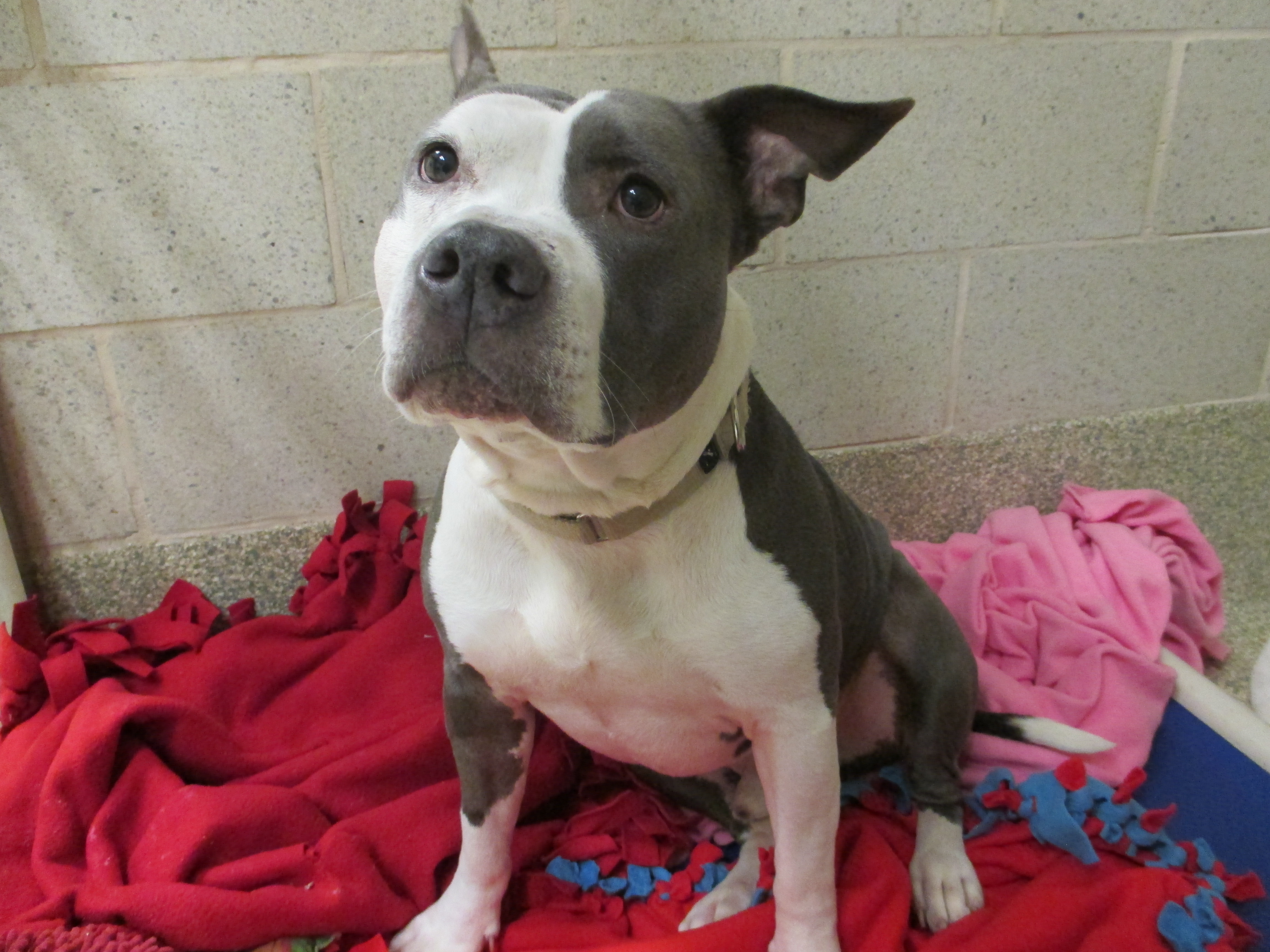
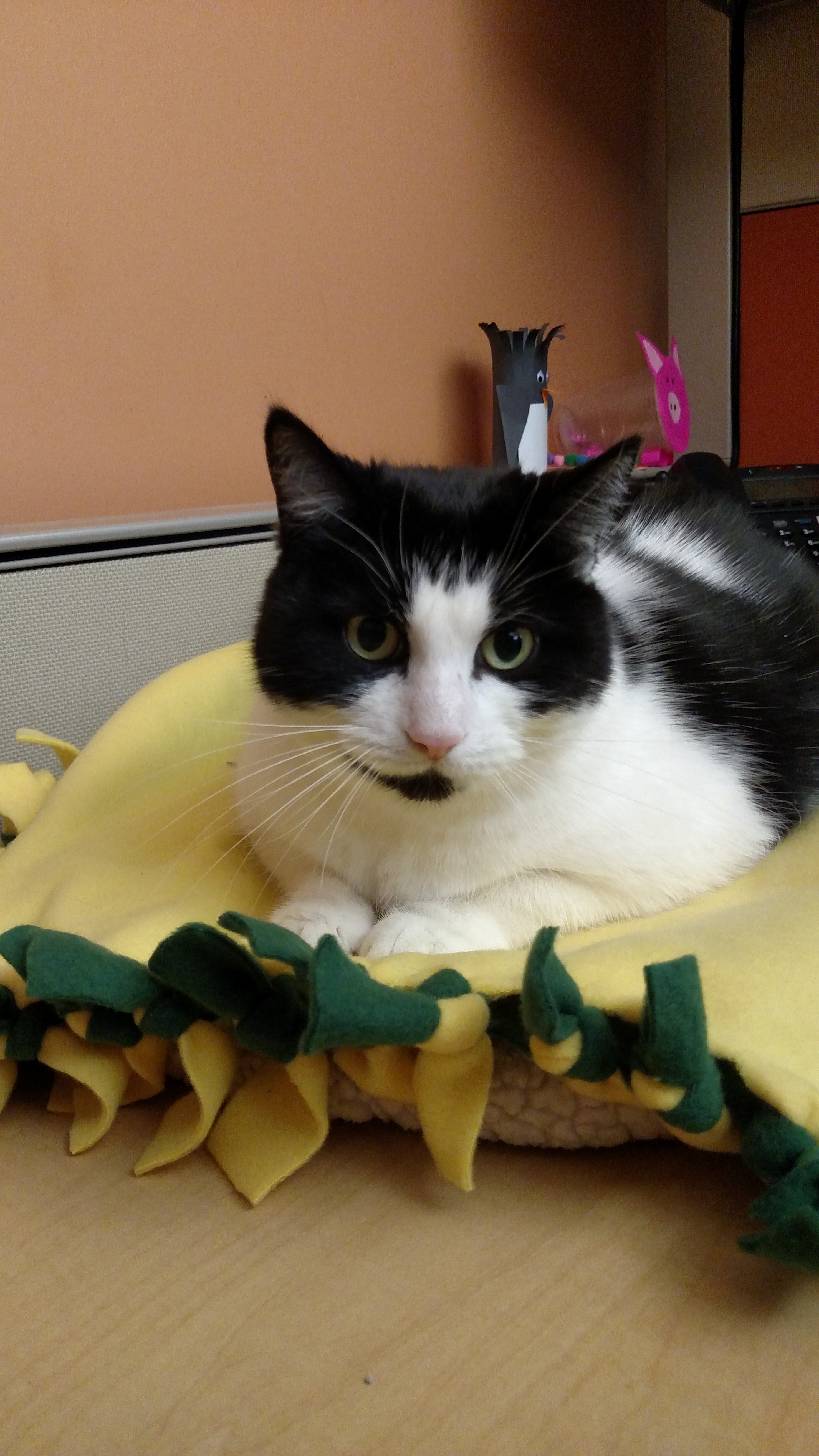
A big thank you to all who participated in our humane education craft during Wild Lights at the Detroit Zoo! We offered an opportunity for guests to make a fleece blanket or kitty play toy that would, in turn, be donated to local shelters. I’m happy to report that many homeless dogs and cats are currently benefitting from your generosity.

I recently dropped off eight large bags to the Humane Society of Huron Valley and many more will also be donated to the Michigan Humane Society in the coming weeks. Once the animals are adopted, their new guardians will be able to bring the blankets and toys home with them. This allows the companion animals to have something familiar in their new surroundings and can help with the transition into their forever families.

Our craft projects are purposefully designed. They are often centered around being kind to animals and the planet – not only does this instill a sense of joy, but there’s research that shows when you’re kind to others, it helps to foster empathy within.

Simple acts of kindness can make a big difference! Want to get started right now? You can find additional ideas on how to help animals at www.detroitzoo.org, www.hshv.org and www.michiganhumane.org.

– Lisa Forzley is the humane education manager for the Detroit Zoological Society and oversees the Berman Academy for Humane Education.